
GIPTM: July 2026

This is a monthly blog post in which I reflect upon and post micro-reviews for every video game I've beaten or otherwise concluded my time with in the month of July 2026. This includes both new and old releases.
Numerical ratings are purely subjective measures of my enjoyment of the game and are conducted on a full 100-point scale in which 50 means that I enjoyed it. Roughly speaking: 0 = hated it; 10 = frustratingly little enjoyment; 20 = seeds of ideas that were not adequately delivered; 30 = some interest; 40 = respectable effort but I didn't quite enjoy it; 50 = faint positivity; 60 = good; 70 = doing something uniquely well; 80 = great; 90 = very special; 100 = legendary.
Key: 🟩 = beaten; ⬛ = not beaten, but I will not be continuing; 🔁 = replay
Bubsy 4D 🟩
2026

Claws but no cigar
Genre: Platformer || 3D platformer
Played on: PC
Fabraz impressed me greatly with this year’s excellent Demon Tides, an expressive, open-world platformer with a great sense of flow and customizability. Its systems supported best-in-class improvisational character movement, encouraging players to find their own ways through its cleverly-designed environments, prompting a speedrun-like gameplay style. When Fabraz announced this surprise Bubsy sequel, built in Demon Tides’ engine and copying its distinctive visual aesthetic, the hope was for more of the same — a victory lap after proving mastery of the genre.
Certainly, there are echoes of the design talent exhibited in Demon Tides. This game is also built around systems of highly-flexible, improvisation, and expressive movement techniques, but the movement systems aren’t as cleverly-conceived and the levels aren’t as expertly-designed. What results is an impressive work of adaptation — a reinterpretation of what (notoriously previously fumbled) Bubsy 3D platforming can be, but it’s made lesser in direct comparison with Demon Tides — a comparison that it invites, to its own detriment.
Controlling Bubsy is a joy at first, but the limitations of the seemingly expressive and responsive moveset become apparent quickly. Mid-air techniques, a double jump, flutter, glide, and pounce, all serve the purpose of extending range and allowing for improvisational mid-air correction, but the moves become somewhat redundant, all essentially serving very similar purposes. Whereas in Demon Tides, there is a logic and rhythm in which mid-air techniques are sequentially triggered, Bubsy’s air controls feel rather interchangeable, and are often used for compensating for mistaken over-shots than giving the character a sense of grace and intentionality.
The stages are (semi-)linear, as opposed to the wide-open playgrounds of Tides, and their design is quite sparse by comparison, echoing the more abstract / less naturalistic spaces of Bubsy 3D. Because of the aforementioned suite of mid-air controls, the levels are built around excessively-large jump arcs. I think back to Yahtzee Croshaw’s review of Alice: Madness Returns, a game that similarly has quite generous glides and quadruple-jumps. He noted that, because Alice’s mid-air range was so long, gaps had to stretch nearly that entire distance to pose a platforming challenge, leading to levels that felt artificially spacious, with empty “in-between” space forming the vast majority of the ludic space. This game runs into the same problem. Bubsy is able to cross such wide gaps that designing challenging jumps requires making use of his entire airborne range, making the abstract spaces feel remarkably empty.
Overall, it’s a solid (if slightly anemic) 3D platformer that would be an impressive display of expressive avatar movement tech if not for the direct comparison to Demon Tides, which does everything that this game does significantly better. There are, on-their-own, great ideas in here, but all of those ideas are better served by Tides.
Innovation the game introduces:
Personally, I love when talented artists work with derided, non-prestigious franchises. There’s a freedom that is afforded in working with “unloved” properties that allows artists to take risks they would not be afforded in more closely-guarded, highly-regarded franchises. As opposed to completely original works, though, the adaptation of non-prestigious properties gives a baseline set of properties on which the artists can riff and iterate. It is a particularly fun challenge to try and find the core appeal in a work or franchise that has previously failed in gestalt and surface a successful work from its “wreckage”.
From Alan Moore’s Swamp Thing run to the musical adaptation of Little Shop of Horrors to John Carpenter’s The Thing, it’s exciting to adapt in an iterative space when people aren’t too precious about the fidelity of that adaptation. Bubsy is the perfect target in the video game space, and I’d be interested in seeing others’ visions of what may become of similarly-poorly-regarded franchises.
What I’d like to see from future games:
Bubsy can transform into a rolling ball, allowing him to pick up speed and launch himself off of ramps, similar to last year’s Isopod: A Webbed Spin-off. Transitioning in and out of this state is a bit unintuitive, though. Particularly when launching to reach a far-off platform, the player has to remember to hit the button to transition out of hairball form before executing the follow-up mid-air moves, an unnecessary extra step that only contributes to the sometimes cumbersome memorization task involved with developing muscle memory.
Lineage and Legacy:
Direct (if slightly parodic) follow-up to Bubsy 3D, previously the only 3D game in the Bubsy series. Built to promote expressive platforming, a passion point for designer Fabian Rastorfer and an evolving movement in game design that can be observed in such games as Super Mario Odyssey, Pseudoregalia, A Hat in Time, and Acroflow.
Score: 66
Librarian: Tidy Up the Arcane Library! 🟩
2026
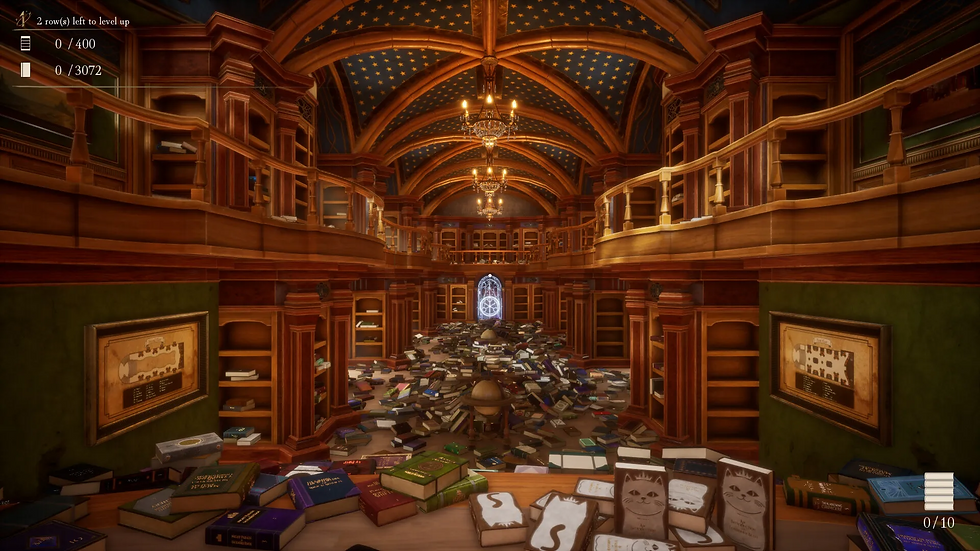
Bippity boppity books
Genre: Simulation || Job sim, cleaning sim
Played on: PC
There is controversy around this game's use of AI, and I recognize that giving it what will ultimately amount to a lightly-positive review runs the risk of further normalizing AI pipelines in game dev, which I am opposed to. Big disclaimer upfront: the elements that the devs have admitted to generating with AI, like book titles and spine artwork, seems like some of the most fun elements to write and design, so I don't really understand why they would choose to optimize the most enjoyable part of their job away. My thoughts, below, are reactions to the game purely as an aesthetic object and how it landed the ideas that it puts forward, but I wanted to give a notice upfront that this game does employ some (major or minor) use of gen AI, and it's reasonable for that to be enough to put someone off entirely.
I hear the objections to cleaning-sim video games: objectively, the time spent emulating the satisfying pleasures of cleaning would be better spent tidying up my actual living space. Narratively, aesthetically, even in terms of encountering novel experiences — these games tend to minimally edify me in the long-term. But it can be nice to develop comfortable patterns and incrementally work at overcoming a large-scale, long-term obstacle of minimal challenge.
I would say that Librarian is marginally more interesting than the PowerWash Simulator lineage, as it (ostensibly) requires an engagement with a sense of organizational, classification logic. You won’t learn the Dewey Decimal System by playing this game, but there’s something about the library setting and the need to intuit the category to which volumes belong through the context of their titles that feels marginally more intellectual than blasting dirt off of a virtual funfair.
The game is set in a Hogwarts-like wizards’ library; a large room with its walls lined with bookshelves. Some unimaginable catastrophe, though, caused every book to fall from its shelf and become intermixed randomly throughout the room. The library’s floor is piled with thousands of loose books, and it’s our job to reshelve every last one of them. We do this by referencing a shelf map at the front of the space and placing each book on the appropriate shelf, alongside the other volumes in its collection.
It makes for a satisfying, minimally-challenging brain stimulation. As shelves are filled, additional magic abilities are unlocked that ease the task. Unfortunately, these magic abilities very quickly remove too much of the already minimal friction, automating the pleasurable tasks into pure busywork. It’s a case of the game giving players the tools to optimize the fun out of it.
I admire the concept and ambition but criticize the game for not sticking to its guns, giving players too easy of an “out” in its overly-optimizable gameplay loop. Between this game games like Little Bookshop, it feels like we’re on the cusp of seeing someone crack a satisfying way to use the encyclopedic / indexical functions of digital games, but this one is not quite there yet.
Innovation the game introduces:
By the time I reached the “postgame”, I had become frustrated by the ways in which the game’s progression system overly-optimizes gameplay, so I was perhaps not as positively predisposed to this feature as I could have been, but there’s something interesting about a postgame mode that allows you to watch the game completely play itself without need for any input from the player. In a Fantasia-like animation, this alternate mode allows you to wander around the library while all of the books magically pick themselves up off of the ground and fly to their respective, correct bookshelves.
What I’d like to see from future games:
It would be fascinating to incorporate some of the actual organizational systems that real libraries use, as well as including actual books, such that these skills may actually be transferrable to real library sciences or research practices.
Additionally, I achieved about 75% completion in one sitting before the game crashed. Despite the game telling me that it was autosaving frequently, I booted it up to find my save file completely erased. It seems that it doesn't actually save unless you quit the game properly. Very disappointing.
Also, future games -- lay off the AI.
Lineage and Legacy:
Follows the lineage of job simulator games, which traditionally aimed to emulate the actual tasks of real jobs with as great of fidelity as then-modern computers allowed, but has since expanded to simulate a greater breadth of fantastical jobs. Librarian also sits in a niche of “one big puzzle” games — games that do not present a sequence of minor puzzles, rather presenting a singular puzzle that can be incrementally solved for the entirety of the length of the game, like Proverbs, detailed later in this same post.
Score: 66
Life Is Strange: True Colors 🟩
2021

Paint with all the colors of the wind
Genre: Adventure || Cinematic adventure
Played on: PC
The Life Is Strange series routinely finds an interesting premise and a neat hook for incorporating their lead characters’ supernatural powers into the YA drama that forms its narrative skeleton, but it often struggles to conclude its stories as the metaphors that undergird its superpowers get complicated and ultimately lost in the escalation of stakes. True Colors simplifies the balance between its two narrative forces: this game’s superpower is essentially amped-up empathy; less “spectacular” than previous powers but potentially more “cooperative” with the person-to-person drama at the story’s heart.
Ultimately, this calculation pays off. The emotional drama feels much more maturely-presented and compellingly-performed than in previous (or latter) entries, forcing players into challenging ethical and interpersonal situations with no clear right answer and genuine emotional complication. It resolves into a fairly conventional story at the plot’s highest level, but the experience is elevated by frequent smaller, intimate, challenging moments of inner-conflict that require greater introspection and ethical consideration than most games of its genre.
That’s not to say that the writing is universally stellar. Character dialogue is still populated with irksome quirks, like characters saying “wait for it…” in the middle of a sentence before delivering a punchline. Similarly, plotting and pacing could be tightened up with greater editorial discipline. Much of the final chapter is spent delivering flashbacks for elements of protagonist Alex’s backstory that were already perfectly understood through implication and allusion. But there’s a great-enough proportion of intelligently-scripted small moments and meaningful choices to balance out these bumps.
If anything rubs me the wrong way, there’s a certain feeling of being in a “Disneyland” version of an indie rock twenty-something’s life. The small town in which the game takes place has four or five points of interest, among them are a vinyl record store, a dispensary, and a hip, woodsy bar. The characters listen to Kings of Leon and draw indie comic books. It all feels so twee and on-the-nose — not that any of it rings false; it’s just that everything in the town is the most obvious version of that particular Garden State / Elizabethtown aesthetic. It all feels so artificially reverse-engineered from what a particular type of person finds hip, it can be a bit distracting.
Innovation the game introduces:
The game’s facial animation is superb. Complex feelings can be read on the faces of its characters, without dipping into the uncanny valley like L.A. Noire (apart from Steph who looks a bit like an AI animation of a Sims character every once in a while). The eyes, in particular, look great, both in their aesthetic realism and in the natural, twitchy ways in which the pupils move.
What I’d like to see from future games:
The sense of community feels well-communicated. Even background NPCs have small, personal narratives that develop over the course of the game. It feels like the game has found the scale of setting that optimally suits this type of story. It would be nice to see this applied to a less familiar setting in the future. Let’s explore character drama in a community of this size in other countries, on other continents, in different modalities of life!
Lineage and Legacy:
This is the second Life Is Strange game developed by Deck Nine, who now have composed more Lifes Is Strange than the series’ originators, Don’t Nod. The series follows the Cinematic Adventure template developed by Telltale Games; an evolution of the Point-and-Click Adventure that truly differentiated and became a separate genre with The Walking Dead.
Score: 74
MOTORSLICE 🟩
2026

I came, I chainsaw, I conquered
Genre: Adventure || Cinematic adventure
Played on: PC
I am a big fan of Regular Studio’s previous game, a truly unconventional 3D puzzle-platformer called Togges. It is a lovingly-designed game that does not shy away from players “breaking” and circumventing its “intended” challenges. It’s a game that is confident enough to allow players to attempt wildly divergent methods of solving its puzzles by experimenting with a surprisingly-deep set of simple, readable systems of mechanics. That kind of confidence and trust in the player is cool — it’s the James Dean swagger of game design methodology. I was eager to find out what this team would do next.
MOTORSLICE is more traditional in terms of genre, but it still shows its “outsider” perspective in the ways it is built. Its mechanics are familiar by name but novel in function. Everything works just a little bit differently than you think it might, based on expectations from a lifetime of gameplay experience. This cuts both ways — it feels fresh and new, prompting conscious and critical engagement rather than passively falling into familiar patterns; but it also leads to moments of “betrayal” of the “pact” between player and designer — costly errors sometimes don’t feel like “my fault”, as I was trying to read the game’s signs and signals using what I thought was a developed, shared vocabulary of gameplay.
The momentum-based platforming and combat feels expressive and creates a great sense of kinesthetic presence. The feeling of presence is amplified by the “honesty” of the game’s sparsely-decorated environments. I’m not getting caught in inaccurate collision boxes around ambiguously practical-or-decorative environmental details — the levels are all fairly spartan (an element it carries over from a key inspiration, Mirror’s Edge). The environment is clean and readable, without sacrificing the evocative qualities of its post-apocalyptic setting. There are even ways to sequence-break platforming challenges with clever use of the space, and the game seems to respect the player for finding her own path through its spaces. Turnabout is fair play!
The sense of presence is also amplified with some great aesthetic effects. Get the camera too close to falling sand, and you’ll see the view cloud up, feel the controller rumble, and observe appropriate screen-shake. Similar to Super Mario 64, the third-person camera is contextualized as an in-world character — a drone following the avatar.
This strong sense of presence pays off with the scale of some of the game’s environments and boss fights. When the camera pulls back to reveal a building-sized enemy baring down on the avatar, it can genuinely make your stomach drop, and it makes the Shadow of the Colossus-like climbing and puzzling-out of enemy weak-points feel epic and heroic.
Innovation the game introduces:
The relationship between avatar Slicer P and her drone is odd. Rest areas are frequent, providing a curated selection of camera angles overlooking the gameplay environment’s brutalist vistas. These moments of rest are accompanied by light dialogue scenes; typically P will reflect on her adventure and the drone (standing in for the player in these moments) is given two dialogue options with which to respond. Typically, one is almost dismissively neutral and the other is weirdly lustful. For a game that frames its female protagonist with a great amount of restraint (on the scale of video gaming) — she is capable and attractive but not in an exploitative or sexualized manner — the persistence of the horny dialogue choice does, in aggregate, prompt a more sexual framing of the character in a way that feels unwelcome and unconsensual. I don’t have a problem with characters being sexual or being framed sexually, it’s just that the persistence of the drone’s comments (chosen by the player or not) and Slicer P’s lack of humoring them with a playful response makes them feel belligerent and unwanted.
What I’d like to see from future games:
The game’s titular mechanic, the motorslice, refers to the avatar’s ability to plant her chainsaw in particular surfaces and propel herself in that direction. This mechanic presents exciting possibilities but doesn’t feel perfected in its implementation. Changing the direction of the slice — one of the basic things that the game asks the player to do frequently — feels frustratingly inconsistent. There is room for improvement.
Lineage and Legacy:
Direct inspiration taken from Mirror’s Edge and Shadow of the Colossus. Fits into the trend of expressive 3D platformers detailed in the Bubsy 4D post.
Score: 81
Denshattack! 🟩
2026

Training day
Genre: Sports
Played on: Xbox Series X (via Game Pass)
A game that defies genre classification, Denshattack! is equally an on-rails platformer in the vein of Subway Surfers and an extreme sports score-chaser like SSX Tricky. You play a train operator engaging in an extreme sport that involves performing crazy aerial stunts in your train — kickflipping, hopping between rails, going off-track and skating across sheets of ice, riding up the walls… It has the energy and audacity of a Hiroyuki Imaishi anime and a SEGA Dreamcast-inspired look that feels just on the right side of the readable / overwhelming divide.
Strip away all of the layers of anime bombast and this game presents three primary challenges: quick recognition of an increasing number of visual cues, gentle timing challenge, and memorization of a growing well of button inputs. Essentially, it’s like a more complex version of the electronic game Bop-It. Recognize the cue, remember the appropriate response, and perform it in time. It’s less expressive and freeform than a Tony Hawk’s Pro Skater, to which I often see it compared; it is closer to OlliOlli.
It feels great to play, though. The memorization load and the attention required for quick sight-reading holds me in the Flow state, and despite how busy the courses are with outrageous anime spectacle, they’re surprisingly easy to (roughly) memorize when revisiting for improved scores. The animation and spectacle make every action feel exciting and larger-than-life. And the amount of bespoke material created for each each stage — environments, weather effects, giant monsters, triggerable events — feels impossible. The amount of detail put into each stage is staggering for a game made at an indie scale. It’s all the more impressive that it’s meant to be rocketed past at high speeds rather than slowly approached and studied. Knowing that someone spent a week of their life modeling, rigging, and programming a particular track decoration that I might see out of the corner of my eye for a half second is humbling.
Overall, whether or not players get on with the game comes down to their tolerance for memorization and recognition tasks. In a way, overloading the memory demands of players keeps the physical controller and the separateness of the player from the game avatar at the front-of-mind. This is not the kind of game in which you feel transparently, projectively connected to the avatar. You’re always aware of the translation from impulse to controller to on-screen result — that never fades. But it has the right amount of demand at all times to keep the player engrossed. It’s one of those “I realize I haven’t blinked in two minutes” kinds of games, and one of the very best of that variety.
Innovation the game introduces:
The overdrive mode achieved by reaching a certain point / multiplier threshold is an interesting addition — it adds new rainbow rails that lead to alternate routes through most of the game’s levels. It makes for an interesting challenge and reward, particularly when juggling other sub-objectives: you not only have to play in a skillful or risky-enough manner to reach a high multiplier — you also have to do it early enough that you can take advantage of those alternate routes. I’ve achieved overdrive too late in courses before, and it’s always a bit defeating to see the ending approach before I have a chance to explore what new options and routes it afforded me.
What I’d like to see from future games:
While this is a recognition-and-response, timing-based game of mastery, its lack of musical integration in the cuing of inputs means that this is not a rhythm game, but I would be very interested in seeing the developers adapt the engine for more rhythmically-based play as a spin-off title. Maybe Aaero is a good point of comparison for a genre-crossing rhythm action game, or even something like Thumper.
Lineage and Legacy:
While gameplay calls back to Subway Surfers and the over-the-shoulder variety of endless runners, OlliOlli, and extreme sport snowboarding games like SSX Tricky, its visuals are clearly SEGA-inspired. Its bright, blue skies and Jet Set Radio-like use of chunky polygons with cel-shaded bright, primary colors and thick outlines, this feels like a Dreamcast game that never was.
Score: 88
Proverbs 🟩
2024

Worldbuilding
Genre: Puzzle
Played on: PC
Proverbs is a game that proves that slight changes in the framing of its material drastically reforms the shape of the game. It is a Picross / Minesweeper-style puzzle game requiring the player to turn on and off cells in accordance with numerical hints on the board. Instead of presenting a collection of bite-sized puzzles, though, Proverbs presents the player with one enormous puzzle that can be chipped away at over-time.
This giant puzzle has over 55,000 cells. It is divided into a couple hundred “regions” (contained portions of the puzzles that effectively function as the segmented puzzles you’d expect from a Picross-style game, but the player can cross regions and solve any portion of the game at any time, in any order. In a way, this feels like an “open world” variety of Picross.
It’s actually a nice way to do it! While you’re warming up to the puzzle-solving logics you’ll employ, you can always go hunting for 0s and 9s on the board — easy to fill in right away — and figuring out “tricks” for solving common configurations can be applied to help fill in gaps in regions you had previously abandoned. It gives the entire game a gentle, at-your-own-pace learning curve.
Picross-style collections are incremental meta-progression challenges, in a way. You always have in the back of your mind how many puzzles you’ve completed vs. how many are left, with the goal of completing the entire collection. This game presents that meta-progression in a more satisfying way, allowing you to zoom out at any time and review the state of the overall image. The satisfaction of tracking the slow, incremental progression along the way is motivating.
Ultimately, this is largely a “turn off your brain” comfort game. Once you learn all of the patterns and logics, it becomes a recognition task. But for something to have on while watching videos or listening to podcasts, it’s well-presented and satisfyingly involving. It never gets as clever as some of the truly great cell-puzzlers like Hexcells, but its “one big puzzle” framing makes it feel like an epic quest — something that even the best Picross or Minesweeper collections rarely achieve.
Innovation the game introduces:
The hint system is well-deployed. It does not solve any of the puzzle for you; it simply zooms the camera over to the nearest block of cells for which you already have enough information to solve. For a puzzle of this size where the solving of particular cells can lead to the information necessary to solve others, it is sometimes nice to be given that “starting point”, from which chains of dependent solving can grow.
What I’d like to see from future games:
The developer has made six games in this “mega mosaic” style, including one (Mosaic of the Strange) that seems to interject narrative elements, as solving these large-scale puzzles helps characters solve paranormal mysteries (which makes me think of Murder by Numbers). Thinking of what else could be done with this formula, maybe there’s a two-layer puzzle involving the construction of a large, mosaic picture and then a hidden-object-style game that takes place amidst the picture that was built, like constructing a Where’s Waldo? and solving it as it’s being built. Throughout the game, we have a list of objects we’re looking for (a top hat, an oven, a poodle…), and we can look for them as we’re building out the mosaic puzzle. It transforms the resulting picture into a gameplay element rather than just a pretty way to track incremental progress.
Lineage and Legacy:
Descendant of Picross and Minesweeper. Part of an ongoing series by the same developer.
Score: 74


Comments