
GIPTM: May 2026

This is a monthly blog post in which I reflect upon and post micro-reviews for every video game I've beaten or otherwise concluded my time with in the month of May 2026. This includes both new and old releases.
Numerical ratings are purely subjective measures of my enjoyment of the game and are conducted on a full 100-point scale in which 50 means that I enjoyed it. Roughly speaking: 0 = hated it; 10 = frustratingly little enjoyment; 20 = seeds of ideas that were not adequately delivered; 30 = some interest; 40 = respectable effort but I didn't quite enjoy it; 50 = faint positivity; 60 = good; 70 = doing something uniquely well; 80 = great; 90 = very special; 100 = legendary.
Key: 🟩 = beaten; ⬛ = not beaten, but I will not be continuing; 🔁 = replay
Corn Kidz 64 🟩
2023

Children of the corn
Genre: Platformer || 3D platformer
Played on: PC, Steam Deck
This recent wave of throwback, retro-stylized 3D platformers based around the technical and design aesthetics of the N64 and PSX era has been successful at evoking a time period visually while not skimping on the design and technical advancements made since then. This is a game that feels modern in its control -- expressive and complex -- in a way that was not yet wholly conventional during the '90s period it calls back to.
Corn Kidz is a bite-sized platformer with a wicked, retro look that feels very Rayman 2. It's built around clever and unique jumping and headbutting systems, corntextualized by the anthropomorphic goat avatar. It's on the more challenging side -- built by and for longtime genre enthusiasts -- but its challenge is mediated by some modern conveniences and sensibilities that keep it from ever feeling cruel.
Innovation the game introduces: I want to call out, in particular, the sound design on the avatar's footsteps. Being a goat, he has hooves rather than feet, and the ways that the footsteps reverberate off of different materials is well-considered.
What I'd like to see from future games: The game has a slightly wicked sense of humor, giving it a fair bit of personality, but I find that this particular type of humor works best in contrast to an otherwise cheery and conventional video game world, like the contrasts exhibited in Conker's Bad Fur Day, whereas this game's world is perpetually dingy and twilight-lit, giving it more of the aesthetic tone of a mildly-comical indie comic like I Hate Fairyland.
Lineage and legacy: Inspired by games like Rayman 2 and Banjo-Kazooie in particular. Fits into a wave of modern N64- and PSX-stylized platformers, alongside games like Pseudoregalia, Cavern of Dreams, and The Big Catch.
Score: 82
KINGDOM HEARTS Birth by Sleep 🟩
2010

Rashomouse
Genre: RPG || ARPG
Played on: PC, Steam Deck
I made a mistake. We're covering KINGDOM HEARTS 358/2 Days on Cane and Rinse later this year, and I can't keep the titles of these damn games straight. I heard the title, immediately though "oh yeah, the one with Terra, Aqua, and Ventus, and never bothered to double-check that I had the right one. By the time I realized I was playing the wrong game, I had already finished Birth by Sleep, so consider that the hardest I've ever dedicated to an easily-avoidable mistake.
But, regardless, Birth by Sleep is my favorite game in the Kingdom Hearts series. As someone for whom Sora is a bit too saccharine and the "anime" aspects of the increasingly complex plot has little appeal, I prefer these protagonists and story presentation.
To be completely honest, I find these games deadly boring to play -- avatar control is slow, floaty, and imprecise, making me feel more like I'm issuing suggestions to a separate protagonist rather than actually embodying an avatar. And the pace of scenario development tends to be stretched dangerously thin in Kingdom Hearts games. This game minimizes the series' weaknesses by keeping each of its stages short-and-sweet, knowing that each will be revisited with each of the three protagonists. It keeps the game feeling propulsive and exciting, something with which Kingdom Hearts has always struggled.
Aesthetically, we can tell that this game was adapted from a PSP game rather than a PS2 version like the previous HD remasters. Character models and especially lipsyncing are quite a bit more crude, but the talent in realizing the series' distinct softness evocative of Disney's animation techniques is still on full display; overall, it's a very attractive game.
Overall, the Kingdom Hearts series still isn't quite "for me", as someone who puts greater emphasis on gameplay rather than story, but this is the entry with which I have connected the most.
Innovation the game introduces: The game simplifies its combat system with an almost card-battling-game-like "deck" of commands that you can scroll through during combat an execute with one button press instead of fishing them out of multi-layered menu systems. Overall, it works pretty well and keeps combat moving, but its primary downside is that all necessary commands must be loaded into the same rotation, causing attack and healing spells / items to fall in the same rotation. Sometimes you need an attack, sometimes you need a heal, and it's too easy to accidentally trigger the wrong one or lose the one you're looking for in the rotation.
What I'd like to see from future games: It's great to see less repetition in the Disney worlds encountered in this world, but it's missing the one or two "Disney-obscurity" worlds we usually get. I love when the series makes very odd picks, like Tron and The Three Musketeers. Let's get weirder with our picks!
Lineage and legacy: After adapting more real-time elements into their turn-based battle systems in Final Fantasies VI and VII and to a much greater degree in Chronos Trigger and Cross, Kingdom Hearts represents Square-Enix's biggest step forward into the melding of real-time and JRPG combat conventions, and the work they did in Kingdom Hearts was further iterated upon and expanded in more recent Final Fantasy titles, such as VII Remake. This particular game's Command Deck system is loosely adapted from the strictly card-based battle systems in Chain of Memories, finding a happy medium between the series' two primary modes of combat to that point.
Score: 71
Walkabout Mini Golf: Blokhaven DLC 🟩
2026

Blocks and putts
Genre: Sports || Golf
Played on: Meta Quest 3
This month's new Walkabout Mini Golf course is the floating city of Blokhaven, a Waterworld-like society out in the middle of the ocean. Its distinctive aesthetic concept, though, is that it's constructed with the simple and colorful shapes of children's building blocks, giving the entire space a "playtime" feel that suits the game's low-poly art style very well.
At first glance, we may ask -- why the building block aesthetic? The game's art style is already quite simplified and iconographic even in its depiction of realistically-stylized places. Does a further level of iconization and abstraction matter that much? The other worlds already feel like Disneyland dark ride versions of their spaces; does heightening the artificiality of the construct make a tremendous difference?
Yes and no. In some ways, it retains continuity with design that already feels like walking through someone's LEGO town or a diorama of toys on someone's shelf. But heightening the artificiality actually increases the sense of imagined, mimetic realism in some regards. Ironically, this world feels the most "lived in" of any of the courses they have yet made because it does the least to insist upon its relation to the real world. It presents a world of block people and block dogs and block boats and presents a world in which these block people and block dogs and block boats could actually live and go about their daily lives in community with one another, and, you know what? I believe in that sub-reality.
Whereas the other courses seem curated and staged for our walkthrough, something about Blokhaven feels strangely natural. Wonderfully mundane. It's less It's a Small World After All and more like where the toys in Toy Story go when Andy's not in the room.
And they use the simplicity of shapes and colors to set up quite a few fun puzzles in the foxhunt, hiding symbols and color combinations in plain sight amongst the patterns that naturally emerge from the course's constructive material.
It's a rather straightforward course from a mini-golfing perspective; on the easier side with only one hole that frustratingly made me max out my stroke limit. It'd be a terrific course to start new players on. Very fun and replayable in its simplicity.
Innovation the game introduces: This course uses a strategically-placed dog poo as a visual clue for one of its foxhunt puzzles.
What I'd like to see from future courses: My only complaint about Blokhaven is the saxophone busker -- a great idea executed sub-optimally. The course's soundtrack (my favorite music backing for a DLC course in a long time) is driven by a saxophone lead, and in a central town square, we see a saxophone player on playing publicly. Get close to the saxophone player, and we can hear him playing along with the nondiegetic music. But he's playing the exact same notes; it's just the same recording copied over, diegetically and nondiegetically. Ideally, it'd be great if he were playing a harmony that we could only hear in proximity to him; something different than what we had become familiar with. Use that moment, part-way through the course, to illuminate additional musical texture.
Lineage and legacy: This follows the tradition of (roughly) alternating between realistic and stylized, fantastical courses. With the last course being based in Hollywood, this course has a more fantastical setting -- though, amongst the fantasy courses, this is probably the most grounded.
Score: 80
Hidden Cats in Spooky Village 🟩
2025

Kitty horrorshow
Genre: Puzzle || Hidden object
Played on: PC
I like this series, and I like fun-spooky aesthetics, so this one should be right up my street. And, while the game's primary, city-scale map that progressively gets colored-in as you go remains a major highlight, I found the game's other image searches to be more annoying than usual, particularly after having played the excellent Hidden Cats in Barcelona (released after this game), which incorporated a progressive-coloring system into the game's other levels, easing the strain in finding the last few cats.
I also find it slightly baffling to release a Hidden Cats in Spooky Village after having released a different game called Hidden Cats in Spooky Town; it will be confusing for people in retrospect, and surely, they must have lost sales from people who say, "I think I've already played that one". I'm up for more fun-spooky, Halloween theming, but some nominative distinctiveness may help on the storefronts.
Innovation the game introduces: There are some unconventional canvas shapes that end up just becoming empty space due to the fact that the game is played in a rectangular window on a rectangular monitor.
What I'd like to see from future games: The next entry in the series introduced progressive colorization, and that's all that was needed to elevate these puzzles.
Lineage and legacy: Hidden object puzzles originated in print publications such as magazines and books. They were adapted to the digital medium in the 1990s with games like Mother Goose: Hidden Pictures and I Spy. They became a dominant genre in the "casual" game space in the mid-'00s. Hidden Cats as a series originated in 2022, amidst other games in which cats are hidden amidst various locations. A competing series, Cats Hidden, has been threatened by lawsuit by this game's publisher, now retitled Travellin Cats.
Score: 71
Wario World 🟩
2003

The plumber of the beast
Genre: Platformer || 2.5D platformer
Played on: Steam Deck
Nintendo games are usually innovative, but it's not often that they're allowed to get properly weird. Some of the most successful "weird Nintendo" moments have come from times in which Nintendo has opened their stable of IPs to other developers, such as Brace Yourself Games' Cadence of Hyrule.
This game is developed by Treasure; primarily known for world-class scrolling shmups (Radiant Silvergun, Ikaruga) and run 'n' gun action games (Gunstar Heroes). They had collaborated with Nintendo previously, most notably in the co-production of Sin and Punishment, an N64-exclusive on-rails shooter. But Treasure was relatively new to the world of 3D platformers, with their only previous game in the genre being the truly bizarre Stretch Panic (also known as Freak Out), and they seem to be pulling from some of that design legacy in the design of Wario World, a game obsessed with the visceral physicality of interaction within the 3D world.
What results is a 3D (most often 2.5D) platformer with a greater emphasis on treasure hunt item collecting than simply making it to the end of each stage. Wario dispatches his foes with wrestling moves, spinning enemies into other enemies and crushing their heads in wicked piledrivers. It feels more aggressive and even mean-spirited than typical Nintendo fare; it encourages fast-and-loose play, demanding brazenness rather than precision and planning.
It also feels "sloppy" in its construction in the way deliberately comedic fan games today might feel; and this is not meant disrespectfully in any way. It works to the game's favor. Whereas its closest mechanical analogue, Yoshi's Story, puts forward a storybook aesthetic that feels deliberately-crafted to the point of aesthetic obsession, Wario's worlds are crudely-modeled, muddily-textured, improperly lit, and enemies look like an unrelated assortment of puppets from a child's toy drawer. It reinforces the "smash and grab" ethos of the game: there's nothing to stand around and admire -- you have permission to disregard the mimesis of the game altogether and focus all of your attention on embodied play; on how it feels to be Wario in a virtual space. Be brash, be destructive, you're not ruining anyone's wedding decorations; you're playing in the mud.
All of this focuses all attention on the gameplay, which is not the best character control system you'll ever touch, but it's flexible and expressive enough to squeeze a robust array of demands out of, particularly showcased in the game's numerous, hugely-varied boss battles. There is a new boss after each level and one more at the end of each world, and they're all slightly more clever and nuanced than you'd expect, requiring you to find even more demented ways to use Wario's bugnuts moveset.
Overall, it's a lot of fun. It's a totally unpretentious, no-holds-barred platforming adventure. I hope we get to see Nintendo go this off-the-leash again.
Innovation the game introduces: If the most memorable moment of Super Mario 64 was the spinning throw that concludes every Bowser fight, this is a game that seems obsessed with one-upping that moment. Not only is picking up an enemy and spinning one of Wario's primary attacks, he can use just about any enemy in the game as a weapon to musou his way through hordes of underlings. It's terrific.
What I'd like to see from future games: Full-body wrestling moves are a good fit for 3D platfoming avatars. They involve that complete, full-body dedication to each decision and redirection of momentum (rather than just gracefully hopping on enemies heads as you pass, or nimbly rolling through them). It feels like there is more to explore in this regard.
Lineage and legacy: A descendant of both collect-a-thon platformers and wrestling games. Most directly follows on from the Wario Land series spanning from Game Boy to Game Boy Advance. Contains some of the wacky, physics-oriented fun of Treasure's Stretch Panic.
Score: 83
Fairune 🟩
2013

Hey, you got slash in my bump. No, you got bump in my slash.
Genre: RPG || ARPG
Played on: Nintendo Switch 2
I admired the cleverness of some of the puzzles of Fairune2, back when I used to work at Nintendo and monitor the Miiverse boards on 3DS, but I've never actually sit down and played through the series properly. With the nice collection bundle on Switch, I sat down to rectify that oversight starting with the first game.
This is an experiment in minimalism: to determine what is really necessary in a 2D Zelda-like game, let's strip out as much as we can and see if it survives. What is the minimum viable mechanics set on which a Zelda-like game can survive?
Combat has been replaced with a "bump-slash" system: simply run into an enemy. If they're within range of your level, they'll be defeated, and you'll take a little damage but also gain some EXP. If you out-level them, they die without doing you any damage nor granting any EXP. If they out-level you, they'll do damage without being defeated and not grant EXP. This system is an approximation of the flow of leveling up in an RPG. All combat is head-to-head, give-and-take matchups, though. There is no reason not to find a safe place to grind enemies until you level beyond them upon entering new areas. The more recent Angeline Era at least included some projectiles and alternative ways in which the avatar may take damage, so that there is a bit more skill involved in combat; in Fairune, damage is a deposit you pay toward leveling up, and there is no reason not to pay that deposit upfront (particularly if a healing station is close by).
The world is small and manageable, and the puzzles are well-telegraphed. It's a small enough space that they can hide small discontinuities in plain sight to signal puzzle navigational solutions without it getting lost in the noise.
Innovation the game introduces: The game is a helpful exercise in minimalism. It's important to level-set; what is actually important to the player experience of a particular genre and what is just frosting that can be whisked away without damaging the appeal at the genre's core?
What I'd like to see from future games: Having an item inventory is the only part of the game that still feels a little "extra"; a bit shaggy compared to everything else. I don't have an immediate suggestion for achieving greater minimalism without compromising the challenge of the puzzles, but it's worth thinking about for games with similar ambitions.
Lineage and legacy: The game's minimalist "bump-slash" combat system went on to inspire 2025 indie darling Angeline Era. Fairune spawned between two to five sequels (depending on what you choose to count), and the developers went on to produce a more fully-featured game with an otherwise similar design ethos, Kamiko.
Score: 75
Tomodachi Life: Living the Dream ⬛
2026

This sim is a bit slim
Genre: Simulation || Life sim
Played on: Nintendo Switch 2
Tomodachi Life is like a heavily-simplified Animal Crossing, and, like Animal Crossing, I have to echo the familiar refrain that "the one on 3DS was better than the one built for Switch".
This game is lightly amusing -- you set up the pieces and let the Miis, even more self-determined than The Sims, go about their lives in hopes that silly things happen. You are not playing as one of the characters; you are a god outside of the system, overseeing and intervening in their lives. It's more like having an ant farm or aquarium than actually playing within a game world.
I played this with my wife, and we always had a pleasant enough time checking in on our Miis. Unfortunately, I feel that is the only way I'd recommend playing it -- as a social game with someone else in the room; as a conversation-starter. Because there isn't a lot to actually do in this game; its primary joys come from watching the occasional silly episode play out on the island and sharing that experience with someone else. By yourself, it's most like watching the world's most lethargic and unimaginative sitcom.
The game is funny occasionally, and the areas in which comedy is most often found -- dreams and social interactions -- seems relatively tame compared to the more imaginative scenarios in the series' previous entry on 3DS. Alas, the 3DS game's best feature -- the music hall, in which you can write songs for your Miis to sing -- is missing entirely.
While the game beefs up the Mii creation options from those which are offered on the console's in-built creator, parrticularly in the numerous additional hairstyle options, the editor is lesser than that offered in Miitopia in 2016, and it's a damn shame that there is no way to transfer Miis or items that other users have created like we could in the Miitopia remaster from 2021. Whereas Miitopia (2021) benefitted from having easy access to Miis of near professional-grade quality (letting me go on an RPG adventure with picture-perfect representations of Earthworm Jim, PaRappa the Rapper, Squidward, and Peppino Spaghetti), no such convenience is possible in Living the Dream. We cannot even transfer Miis' makeup from Miitopia, if a save exists on the same system, as the makeup systems are apparently slightly different and incompatible. It's a very disappointing fault. Being able to quickly and easily load the island with picture-perfect Miis of characters from all kinds of properties, created by players across the world would turn this into a much more amusing sitcom-generation system. This is a tremendous missed opportunity.
Despite all of this, we've grown quite attached to our Miis, from the Miis based on ourselves to Miis built to resemble existing characters (like Chop Chop Master Onion and Shrek) to original characters dreamed up in the game's easy-to-use Mii editor (like our favorite, the diminuitive, mohawked robot named Robobobo). We've seen Miis marry, move in together, go on globe-spanning adventures... but it all seems a bit shallow and lifeless unless you have someone else with whom to share it.
Innovation the game introduces: The primary redeeming feature of this game is its complete lack of content filter. With how little else there is going on in the lives of these Miis, you have to make your own amusement, and there's plenty to be had with the fact that these Miis will say anything you prompt them too; a surprising turn for a Nintendo game. It always makes us chuckle when Miis meet up to chat about jerking off or eat photo-realistic kittens as food. It's childish, but when the game offers so little else, it can be quite amusing, particularly in contrast with the game's otherwise cutesy aesthetic.
What I'd like to see from future games: A more complex life sim is preferred. It doesn't need to be as complex as The Sims, but it would be great if there was a bit more going on in these Miis' lives. Let friendships, love triangles, and even crimes emerge without waiting for direct player intervention. Ideally, this should be something of a narrative-production engine, and I feel like I'm getting very little emergence from the game -- the comedy all comes from my own inputs.
Lineage and legacy: This is the third game in the Tomodachi Collection series, following entries on Nintendo DS and 3DS. It was originally conceived as a tie-in game to the Hamtaro anime series; a series about a group of hamsters.
Score: 41
Mixtape 🟩
2026

Teenage dream
Genre: Adventure || Cinematic adventure
Played on: PC via Game Pass
Games are so much about self-expression and player agency that sometimes it’s hard to also justify their position as author-expressive artifacts as well. Of what value is an inscribed story or philosophy when players have the ability to undermine the “intended” perspective at every turn through their interactive affordances? Mixtape swings far to the side of authorial voice, almost muscling the player out of the picture altogether, but unlike similarly heavy-handed games, the narrative framing — reliving the heightened emotional memories of times gone — puts the castrated player and the avatar character on the same footing: what’s done is done; we cannot change the results of our memories, but we can choose how we remember them on an emotional and even spiritual level.
Mixtape is far more of an expository expression than most games. As others have noted, several of the minigames hardly even require controller inputs. This is not a test of skill -- it's an exhibit of playful recollection. It's an experience of the vividness of memory and imagination rather than a demand of gameplay mastery.
Similarly, its playlist and specific and curated. It's not reaching towards universality; it's demonstrating a point -- how ephemeral moments can be amplified and "captured" in songs and those feelings accessed later through emotional resonance. Or, conversely, how songs can be used to hide, distort, or bury unwanted experiences and feelings.
Most scenarios makes use of non-literal physics or unrealistically-heightened scenarios to demonstrate an emotional state. Whereas the game is light on risk of failure and player inputs do not typically lead to highly-divergent outcomes, interactions tend to allow play with the world in toy-like ways.
For example, in a memorable scene of melancholy which sees avatar Stacey floating backwards through the town and back into her bedroom after witnessing a betrayal of trust by one of her best friends, the course of movement is on-rails and automatic, but Stacey can be nudged back and forth to topple physics objects in the environment: tables, chairs, stacks of paper... The scene, framed like Spike Lee's signature "floating" tracking shot he's used in several of his films, employs a feeling of passive inevitability mirroring the inescapable melancholy, while the disruption of physics objects (sending them floating lazily and satisfyingly into the air in anti-gravity slow motion) represents the kind of repetitive preoccupation the mind focuses and holds onto when trying to ground itself, like kicking a pebble down the road. She imagines turning her sadness into anger, kicking objects over all across town, but even that impulse is neutered by the haze of her sadness; the objects can't work up the energy to be disturbed either; the world is suspended in the same stupor she experiences.
The game is full of textured ludic metaphors. It feels much more emotionally vulnerable than most other games of its type. As an impressionistic exploration of how the heightened state of being a teenager feels and the ways in which we use art to make sense of our messy emotional landscape, it's a very successful meditation. Its closest kin may actually be the works of Tale of Tales, with which it shares a dreamy surreality in the exploration of emotional and spiritual expression.
Innovation the game introduces: I am beginning to notice a trend in games like these — heavily-curated, multi-modal minigame collections that thrive on their diversity of actions. At about the 15 or 20% mark, they introduce the game’s silliest stage; usually a colorful, fumblecore fantasy with light gross-out elements. Consider Split Fiction’s pig stage and this game’s tongue kissing minigame. They hit near the beginning of the game, but not right at the beginning — after just enough time has passed to form an expectation of how the game operates but still early enough to not know how far it will push its ludic conceits. It serves as an early warning shot — “we’re not afraid to get this silly!” that raises expectations and opens the player’s mind throughout the rest of the adventure. It’s interesting to see multiple games place “that scene” at the same arbitrary point in the story.
What I'd like to see from future games: It's a small thing, but I was charmed by the attention to detail in the shopping cart scene. With wheels that can pivot 360 degrees, of course it doesn't turn and control in the way that a car would. It's a clever way to contextualize the linearity of the on-rails chase. I challenge other games that want to employ similarly-restrictive linear sections to find as clever of ways to justify the removal of agency.
Lineage and legacy: A follow-up to the team’s previous music-themed, coming-of-age, nominally-interactive The Artful Escape. Exploration between minigames owes its structure to The Walking Dead, which, itself, is an extension of the point-and-click adventure genre.
Score: 85
Horse Magnifier: Jam Edition 🟩
2026

A horse is a horse, of course, of course
Genre: Puzzle
Played on: PC
A simple idea done well -- the game presents a distorted image of a horse, its source image, and a series of magnification tools and tasks you with matching the image. It's a "how did we get here?" puzzle that requires careful observation and reckoning with the tools at your disposal.
This version, created for a game jam, is short and deliberately crude, but it is being expanded for a full Steam release later this year. The concept is strong, and the casual, silly framing the game presents sets just the right tone.
Innovation the game introduces: The ideal form of a trial-and-error puzzle, and one that makes experimenting fun. At every step along the way, your distorted horse is amusing in its distortions. Even when you get it wrong, you're always smiling.
What I'd like to see from future games: With a more robust set of tools, this framework could even work as an educational tool, perhaps demonstrating the ways in which beauty models are PhotoShopped, or even the ways in which AI repurposes and distorts sources of information.
Lineage and legacy: This feels very much like playing PhotoShop Tennis with friends. It turns observation of a distorted image into a deductive puzzle.
Score: 76
Forza Horizon 6 🟩
2026

Running in the 90s
Genre: Racing
Played on: Xbox Series, PC via Game Pass
Maybe the platonic ideal of a driving game; as polished, as expansive, as detailed as you'd want a arcade-sim to be. Pleasurable at all times and constantly rewarding the player with new cars and slot machine pulls. Do the thrills seem a little shallow? Sure. But taking as an expression of the joy of driving rather than as a deep, involving racing game, it's hard to top.
Japan is a great setting, and I really like the way that the map is laid out. It's quite a bit more varied that some of the series' previous maps. It also feels like even more of the friction has been stripped out of the game so as to not pull players out of that "flow" state. You can now drive through just about any tree on the map, making going straight through forests a relatively risk-free venture. It makes the game feel ever more removed from the dangers and risks of real racing, but, alas, it's nice to be able to tear through the map in just about any direction and not get caught in quite so many collisions. Are we being fed baby food with a little spoon, as the game curates only the pleasures of driving without requiring much from the player? Again, sure. But it's not making any claims to be anything more than that -- it does not insist upon its own seriousness -- and it excels at being a "just for fun" racer.
Innovation the game introduces: This game makes better use of the open-world map than past Horizons with a greater proportion of point-to-point races than circuits, but I'd love to have races that aren't quite so prescriptive in their routing. Like Burnout Paradise before, it would be great to have "reach this point by any means necessary" races and let players determine their own routes through the game world! Though perhaps the constant streamlining of navigational challenges, such as the removal of threat of trees, makes this somewhat redundant -- there are fewer and fewer considerations that complicate the "the shortest distance between two points is a straight line" calculation in each successive Horizon game.
What I'd like to see from future games: The Japanese setting has been the ultimate "break glass in case of emergency" switch that the series had in its pocket. It's been the most heavily-requested region for one of these games. Now that they've satisfied the fanbase's #1 pick, where does the series go from here? How is Horizon 7 anything but a step down? My pitch is using real map data and procedural generation to recreate a 1:1 scale map of the entire United States, allowing you to race through every street, every avenue, every road in the continental States, populating each area not with exact replicas of the buildings you'd find in each location but regionally-appropriate approximations. From the map data, you can determine the location of homes, businesses, schools, public buildings, etc. -- the task of the artists would be to create a set of assets from which the procedural map could populate the space -- this is what a $750,000 house in Seattle looks like, this is what a coffeeshop in Santa Fe looks like, this is what mixed-use buildings in Minneapolis look like... And let people create their own races, from their childhood homes to their elementary school -- or even Cannonball Runs from coast to coast over multiple sittings!
Lineage and legacy: The sixth game in Forza's Horizon subseries which has now eclipsed the primary Motorsport series, with which it shares an uneasy kinship. While Motorsport is a more serious simulation racer, Horizon is closer to being an arcade racer (on the Mario Kart, Burnout, and Out Run side of the spectrum).
Score: 85
I See a Butterfly 🟩
2026
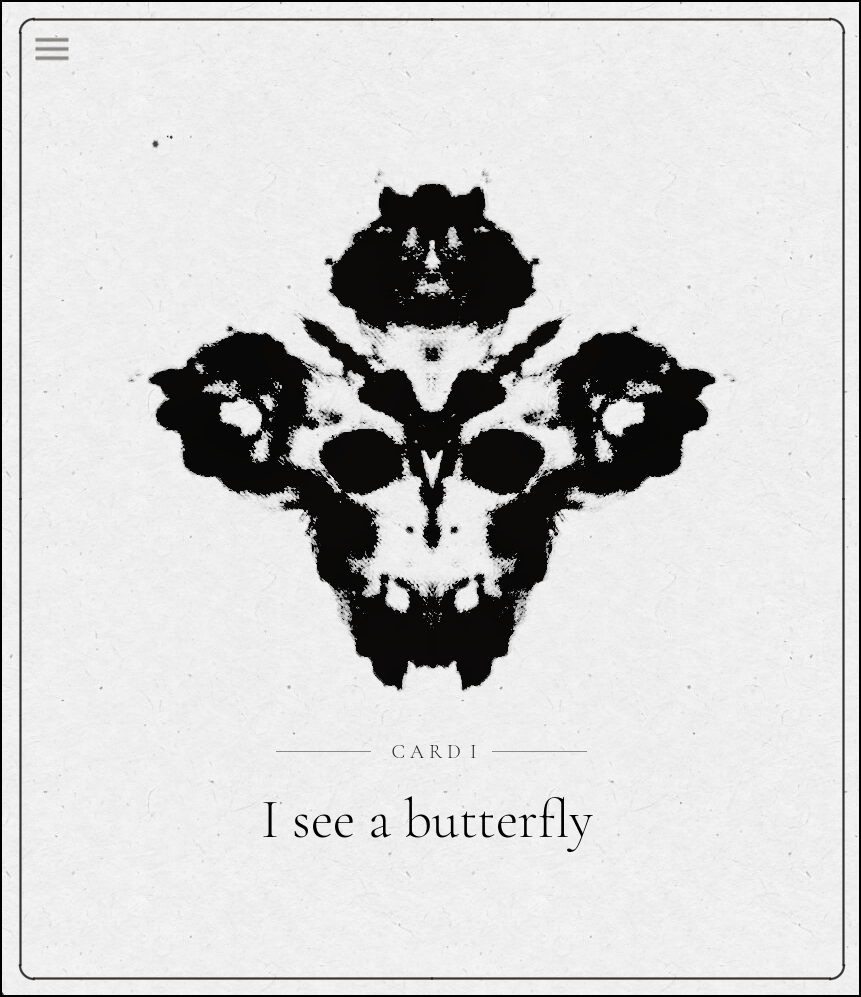
What are you inking about?
Genre: Puzzle, horror
Played on: PC
A short narrative-puzzle game involving Rorschach inkblot tests. The game designates a shape that you "see" in the inkblot -- an image mirrored in two directions -- and you have to use your mouse to adjust the kaleidascopic image to "reveal" the image hidden within it that matches the prompt.
As a puzzle, using the controls to realize the intended image can be a bit clumsy, but the game does not penalize you for taking too long or experimenting with your approach, so the imprecision of the realization of your intended image never becomes an obstacle. If anything, it helps put you in the mind of someone battling their own cognitive perceptions and recollections in the aftermath of a tragic (and criminal) event.
Innovation the game introduces: The game is effective at a particular type of scare -- the hidden-in-plain-sight, dawning realization. While I and rather contemptful for jump-scares, I appreciate the effectiveness of their more patient cousin -- putting something on-screen and letting it scare you as you slowly come to percieve or understand it yourself. I frequently point to effective uses in Inland Empire and The Host: they will keep an image on-screen and gradually distort it or move it closer to you such that there is no JUMP -- no singular point-of-inflection. It is up to you to recognize the horror and feel slightly violated that you had been looking at but not recognizing the horror in front of you for the period before it triggered your response.
The puzzles in this game evoke that feeling, as you get hints of the image you intend to build before, over-time, coming to a clearer realization of the overall image. In this case, none of the images are themselves scary, but the dread lingers in the mind, and were they to hide something terrifying in puzzles like these, they have a good mechanical basis on which to realize that particular horror.
What I'd like to see from future games: Alternate, hidden images hidden within the puzzles would be particularly effective. Imagine seeing the hints of the image you're working towards and trying to nudge the pieces into place, only to be met with an unexpected, darker image. That would play to the conflicted psyche of the POV character and emphasize the horror themes.
Lineage and legacy: Gameplay is evocative of shadow or perspective puzzles as can be played in games like Anamorph and Shadowmatic.
Score: 68
LEGO Batman: Legacy of the Dark Knight 🟩
2026

What weighs six ounces, sits on a toy shelf, and is very dangerous?
Genre: Platformer || 3D platformer, sandbox
Played on: Xbox Series (game received for free)
Is it frivolous to say that this might be my favorite Batman story? Batman has, famously, existed in many different forms over his nearly 90 years of patrolling the streets of Gotham City. LEGO's mission in adapting Batman into its long-running video game series for anywhere between the fourth and eighth time (depending on whether you count LEGO DC Super-Villains, The LEGO Movie games, and LEGO Dimensions) is to draw upon Batman's entire media legacy and create an original story that melds that entire complicated history together. The result is a smartly-conceived, immensely-entertaining tale that contains and elevates nearly a century of Batman material into a world in which can support and draw surprising pathos from that diversity.
The LEGO games have always struck a delicate balance in their adaptations. The familiarity and appeal of their chosen IP source of adaptation (be it The Lord of the Rings, Marvel comics, Harry Potter, etc.) is necessary to their success; they get audiences in the door. The manner of adaptation varies, with some of their most successful games being original stories set in those universes (such as LEGO Marvel Super Heroes and LEGO DC Super-Villains) while their biggest stumbles tend to be in the production of adaptations that feel too slavishly-adherent to the stories on which they're based (LEGO MARVEL's Avengers comes to mind). Most games fall in a middle-ground of utilizing the story beats and structure of the films on which they're based while being pretty loose in their lightly-parodic retellings of those stories. Still, the team sometimes flies too close to the sun, tempted by increased fidelity to the source material and ends up getting burnt -- most notoriously in the utilization of actual voice samples from the movies in LEGO The Lord of the Rings and LEGO Marvel's Avengers, which end up feeling muddled and lifeless in the context of a LEGO game -- voice acting for cartoons (which this essentially is) and acting for live-action are two different disciplines, and the performances do not survive the transition!
So I did not know what to think about the proposition that Legacy of the Dark Knight put forward: it's a loose adaptation (yay!) of specific Batman movies (hmm) published by the studio who has the most to gain from worshipful fidelity to those specific films (uh oh). Would the TT writers get the opportunity to tell a story that properly suits the narrative needs of a comical, child-friendly platformer sandbox? Or would their creativity by stifled by the demands of inclusion of and fidelity to such an overwhelming media legacy? (Find out next time: same bat-time, same bat-channel).
I'm pleased to say that they managed this balance expertly! The stories echo and quote various Batman film, TV, comic, and video game stories but interweave them into their own chronology and take liberties with their specifics, such that the recognizable elements add texture to what is primarily an original Batman story.
And it is a story that benefits from the multiplicity and reoccurring loops in Batman narratives. Each character's performance is primarily based on one or two on-screen adaptations. Jim Gordon and Catwoman are primarily based on Jeffrey Wright and Zoë Kravitz from Matt Reeves' The Batman, while Mr. Freeze and The Penguin primarily refer back to their characterization in Burton and Schumacher's films from the '90s. But those versions of the characters will find themselves playing within stories and donning costumes specific to other versions of the characters. Sometimes these multiple iterations are even more elaborately blended: Jack Nicholson's Joker takes on Heath Ledger's characterization after his first defeat and being knocked from a building -- something that reads as character development rather than decades-later recasting. In this way, the stories feel grounded in specifics but accommodating of everything that a Batman story can be.
The performances are (mostly) great! The Jeffrey Wright voice impersonation, in particular, is spot-on. The writing is sharp and funny across-the-board, with clever references to not only Batman media (the unlockable costume based on the Batman NES game was a nice surprise) but to an unexpectedly-diverse array of other media as well (I was not expecting to find a reference to the Police Squad TV series in there). It all feels comical but respectful, and as a fan of the more esoteric stories like the 1966 film and Batman Beyond, I felt seen. It was clear that this was made by obsessives who love all forms of Batman, not by a company managing the IP by pumping up the visibility of the latest iterations of the characters only.
Legacy of the Dark Knight is the best game that carries the LEGO brand, but it's not the best at being a "LEGO game", if I can make that distinction. If we take "LEGO game" to indicate a specific set of conventions, iterated upon by the dozens of games TT has developed previously, this game abandons particular traditions. Fans of the series going in and expecting another conventional LEGO game will find certain series staples missing. Gone is the mix-and-match gameplay with enormous casts of characters; all gameplay abilities have been centralized around a small handful of characters, giving the game's lock-and-key ability puzzles less of a feeling of creative freedom-of-approach. Red brick gameplay modifiers have been foregone; red bricks are now cosmetic color schemes for each of the game's costumes.
The biggest change from previous LEGO games is the way that stud collection and multipliers work. A core, lizard-brain appeal of previous LEGO games has been the reward of environmental destruction with the collection of seas of studs, with the challenge of meeting a "par" value in each stage. This was also paired with the sicko pleasure of purchasing stud multiplier red bricks that not only amplify the number of studs you collect but also stack with one another. In previous LEGO games, one of my greatest pleasures was trying to get the stud multiplier red bricks as soon as possible and building up the truly ungodly collective stud multiplier of x3,840. Sometimes, stud collection pars would be met even before the end of the level's introductory cutscene. As a basic "numbers go up" pleasure, nothing beat that.
Instead, stud multipliers (which cap at x4 now) are active and must be maintained. The multiplier increases when studs are collected and decreases after a set amount of time having not collected any studs. This compels perpetual forward progress and destruction and hangs a cloud of anxiety over the entire gameplay experience. I don't want my multiplier to drop, so I have to find something to break quickly! It discourages spending time intrinsically admiring the craft of the world and punishes not catching onto puzzle solutions immediately. The multiplier even drops during cutscenes and unskippable animations (such as opening chests). It feels like the game's most serious misstep.
Otherwise, gameplay is solid; not exceptional, but solid. Combat is based on Arkham Asylum's systems, and it's pretty good while being a bit simple and damage-spongey. Navigation of the city is pretty fun (again, with a grapple hook system straight out of Arkham City) but with just enough little annoyances to locomotion to make it not as natural as you'd want it to be. Driving fits cleanly into the bucket of "better than you'd expect it to be, but not good enough to support its rather demanding time-trial races". But the world is jam-packed with things to collect and little puzzles to solve, and each of the linear levels is pretty entertaining and creative.
Ultimately, I miss having frequent, low-stakes, middling-quality LEGO games coming out at a regular clip. Making each new LEGO game an epic of such high production value that rethinks the series' basic tenets and spends multiple years in development slightly misses the point. LEGO games are good for their nimbleness of design and "disposability". They're relatively easy to produce and adapt well to a volume model, so they can take swings on odd adaptation choices that wouldn't pay of in higher-stakes adventures (at its peak in LEGO Dimensions, when we got adaptation of truly bizarre franchise choices like The Goonies and The A-Team). I like when LEGO trends towards the esoteric, and their push for increasing the scope and quality of each game lately means they can only take these big swings on the largest, safest properties. And that kind of misses the point. At that point, why is the LEGO aspect even needed? Just justification for being a bit more overly comical?
The magic of TT's LEGO series is that they were able to create a formula that makes iteration fairly turnkey and low-stakes. They can take a gamble on The Hobbit or The Clone Wars or Ninjago because, if it does poorly, they'll have another one that has a better chance of connecting coming out the next year. It filled the gap of the mid-budget movie tie-in games from the PS2 era -- it ensured a familiar, always at least somewhat successful gameplay system onto which any IP could easily project. Much easier than building new gameplay systems from scratch for each IP like we used to do. Now that LEGO is essentially out of the quick-turn, annualized adaptation game space, no one is really doing that anymore.
All-in-all, this is a terrific Batman story, if rather unconventional for a LEGO game. Sure to entertain, but signals a further step away from what the LEGO series specifically does best.
Innovation the game introduces: Video game-to-video game parodies are surprisingly rare, so seeing the memorable opening of Arkham Asylum recreated in such loving detail alongside Batman's cinematic legacy was exciting and unexpected.
What I'd like to see from future games: Let's settle on a conventional gameplay structure again and get back to rapid iteration. Legacy of the Dark Knight and The Skywalker Saga before it have been such major refinements and such huge swings from a production perspective, it would be nice to take those improvement and start annualizing (or semi-annualizing) the series again to make experimentation with "lesser" (or riskier) properties more feasible.
By all means, though, let's continue this adaptation ethos! The mixture between direct reference and service of an original story is the best that the series has managed so far. I wonder what other media properties have the diversity of stories to support such an expansive adaptation... LEGO James Bond? LEGO Godzilla? LEGO Journey to the West?
Lineage and legacy: A continuation of the series of LEGO cross-IP adaptations that began with 2005's LEGO Star Wars: The Video Game. Incorporates gameplay elements of Rocksteady's Arkham series.
Score: 82


Comments