
GIPTM: March 2026

This is a monthly blog post in which I reflect upon and post micro-reviews for every video game I've beaten or otherwise concluded my time with in the month of March 2026. This includes both new and old releases.
Numerical ratings are purely subjective measures of my enjoyment of the game and are conducted on a full 100-point scale in which 50 means that I enjoyed it. Roughly speaking: 0 = hated it; 10 = frustratingly little enjoyment; 20 = seeds of ideas that were not adequately delivered; 30 = some interest; 40 = respectable effort but I didn't quite enjoy it; 50 = faint positivity; 60 = good; 70 = doing something uniquely well; 80 = great; 90 = very special; 100 = legendary.
Key: 🟩 = beaten; ⬛ = not beaten, but I will not be continuing; 🔁 = replay
GlitchSPANKR 🟩
2025

So long, and spanks for all the glitch
Genre: Adventure, puzzle || Exploration adventure, comedy
Played on: PC
Games that bill themselves as capital-C Comedy Games live and die by the extremely subjective measure of how funny the player finds the humor. Given that game humor is my current area of study, this caught my attention (after being recommended to me by Cane and Rinse podcast mate Darren Gargette).
Subjectively, I think this has a pretty good script and good comedy performances. The shifts in framing are surprising and amusing. I think that it is a pretty good comedy game with many (moderate) laughs. Performance of the main character, Spunk, a glitch that instantiates most often as a talking toilet with a voice like Brak from Space Ghost: Coast to Coast, is funny, menacing, and sympathetic. It's a versatile performance upon which the entire game rests, and the actor pulls it off admirably.
Now to be a bit more "scientific" about it. Distinguishing between procedural and written (or otherwise pre-baked) humor, this game's comedy draws heavily from its pre-prepared materials as opposed to the actual play and operation of the game. This isn't a criticism -- it's hard to write a comedic premise that withstands this game's ~7.5 hour runtime, and they succeeded in that regard! But since my area of study is in emergent humor or humor through play, this game does not meet that criteria most of the time.
Let's start with the missed opportunities. The big one is the core virtual-physical interaction in the game: the avatar's primary means of interaction with the virtual world is with a rubbery spanking paddle that bends, jiggles, and wobbles while moving, giving it the feeling of a flyswatter. I like this setup -- it teases a promising and satisfying virtual-physical interaction.
Unfortunately, it does not feel good to slap (spank) objects in the game, and the jiggle physics of the paddle are so loose that it does not even feel like a weighty, physical object. Its jiggle is so extreme with every movement that it feels weightless. The refresh rate can't even keep up with its movement, so it's being drawn in multiple places at once. It creates a "slapping zone cloud" rather than creating satisfying moments of slapstick connection between paddle and object.
If the physics were tuned more tightly, it could give the stick a better sense of heft and better sell the slapstick pain of the character receiving the spanking. As it is, it looks like the paddle is more likely to tickle or annoy than to painfully slap, and that presents a problem, since that slap is the single core mechanical interaction in this game. The fact that it is undersold hurts every interaction within the game.
Secondly, I wish that the game structured more of its humor around more authentic visual language of glitches. The game's antagonists are ostensibly introduced as glitches in a piece of software, but they behave like glitches would in a Saturday morning cartoon rather than how glitches actually operate in real computer software. I won't press this point too much, since I'm just wishing that the game did something that it did not set out to achieve, but I just think there's a lot of humor to be mined from players' collective experiences of actual forms of glitches; making actual glitch comedy (even if the glitches themselves are artificial) would be a braver and potentially more rewarding artistic feat.
To turn toward the positive, I'd like to share a few beats of procedural / interaction-based humor that I do find quite successful in GlitchSPANKR:
Interface literalization
Subtitles from the speech of a certain character fall and pile up on the ground after he speaks.
Spunk tries to trick us with a fake loading screen that is actually a level. We just turn the camera to see the room behind us. Were we not to move the mouse, we would be looking at what looks like an infinite loading screen. The joke becomes funnier the longer the player is "fooled" into waiting.
Unexpected interaction
Putting the hand in Spunk’s mouth while he’s speaking replaces his speech track with a muffled track. It seamlessly transitions back and forth as the hand is inserted and removed.
Cutting the veggies in the kitchen plays out like a horror movie. Sounds of slicing, screaming, baby crying, dramatic music and lighting.
Deus ex mechanic
A level in which all objects were strengthened to be able to withstand 100 spanks was created as an intentional time-waster, but we get a special ability for that level only to be able to explode and destroy all objects in a range instantly.
Innovation the game introduces: The most surprising moment of the game is when the supporting cast is "deleted". They're exploded with a laser, and the broken pieces of their voxel bodies float around in space and are interactable physics objects. It's morbid and darkly funny to be able to push around and gather up pieces of Spunk the talking toilet.
What I'd like to see from future games: The physical interaction of the titular "spank" could be improved significantly to create more satisfying interactions throughout the game.
Lineage and legacy: Would pair nicely with There Is No Game: Wrong Dimension, another comedic game about a computer program struggling with loneliness enacting glitches to prevent you from playing your desired game. That game also switches genres and gameplay conventions with each scene.
Score: 67
BubbleBeast DigiDungeon ⬛
2024

Beast-a-Move
Genre: Arcade || Tile-matching
Played on: PC (at GDC)
This is a solid arcade riff submitted as a student game for GDC's IGF selections. It's a Puzzle Bobble / Bust-a-Move-style match-four game in which the bubbles float around the center of a circular playfield rather than hang rigidly at the top of a unidirectional board. The cursor, which fires additional colored dots, pivots around the growing mass, and the clump of tiles is imbued with physics, such that firing new tiles into the mass will cause the entire mass to shift and move.
I am not an expert in Puzzle Bobble, but this struck me as a fairly successful experiment with the genre. I am also not familiar enough with the genre to know if anyone has attempted something specifically like this before.
Tiles are fired automatically, in time with the background music, so the player has to think and move quickly to keep up. Overall, it's a solid and satisfying set of mechanics executed well. Genre-wise, not one that I see myself obsessing over, but I'm glad to have played it.
Innovation the game introduces: The most interesting aspect of the game's presentation is its framing within what appears to be an anonymized and altered 3DS system, and there are some clever touches that call back to how 3DS games looked (such as the funny behaviors of objects that move between screens). It insists upon a time-and-place in gaming history and invokes a context of play that sets it apart. I really like this (literal) framing device as a way of calling back to the types of games and the culture of game consumption that inspired this entry.
What I'd like to see from future games: To further riff on the 3DS framing, it could be funny to find ways to fake the system's 3D presentation even in a flat-screen setting to create the little pops of pseudo-3D that were obligatory amongst the games on that system.
Lineage and legacy: The basic gameplay is a riff on Puzzle Bobble (Bust-a-Move) with a hint of Zuma. It is framed within fictional hardware intended to evoke the Nintendo 3DS.
Score: 70
Do Touch That Dial ⬛
2025

I saw the TV glow
Genre: Adventure, puzzle
Played on: Custom hardware (at GDC)
Played in GDC's alt.ctrl section (games built to support custom control interfaces; typically student projects or one-of-a-kind experiments), Do Touch That Dial uses a CRT TV with which the player has several points of interaction. The player can adjust the volume and channel buttons, the power button, rotate the bunny-ear antenna, and even slap the side of the TV.
On-screen is a semi-randomized assortment of programming: a game show, news broadcasts, footage of a 2D fighting game that closely resembles Street Fighter II... these segments can "malfunction" or be interrupted by cute-comic-creepy invaders that have to be "combatted" through the aforementioned interactions (such as turning the volume all the way down to prevent an evil children's show puppet from reciting some kind of incantation).
The interactions are clever and not over-explained. The "gotta figure it out myself" type of play feeds really nicely into the creepypasta aesthetic that it's trying to reach.
My only big reservation about the game was that the video material featured in this game was AI-generated. It's not obvious (apart from feeling like it has too high of production values for a project of this scope), and transitions / corruptions are handled well, but it's disappointing to see a game with this much generative AI content in such a curated collection.
Innovation the game introduces: I have never seen volume control being used so effectively as a game mechanic. You can feel the monster resisting the volume decrease as well.
What I'd like to see from future games: This is a promising angle, but I'd like to see this done without genAI content.
Lineage and legacy: The aesthetics of public access TV has been played with in Not for Broadcast and Blippo+. This is a riff on the "haunted public access TV" trope common in creepypasta and indie horror films (especially on YouTube).
Score: 59
The Cap Circus ⬛
2025

A pick 'n flick adventure
Genre: Arcade
Played on: Custom hardware (at GDC)
This is a ski ball / pachinko-like alt.ctrl game featured at this year's GDC. Select a plastic bottle cap and flick it into the slot beneath the screen in this custom unit to see the cap "digitized", dropping from the top of the screen through a series of moving rings. It's an impressive illusion (in reality, the caps are triggering a series of pressure-sensitive paddles that can detect velocity and angle of movement). Really slick; it works very well, and it feels more polished than most alt.ctrl games tend to feel.
Innovation the game introduces: The internal paddles seem to be tuned very well; it felt like it was authentically replicating my angle of approach every time.
What I'd like to see from future games: In this game, the cap is flicked in through the bottom and then drops from the top of the screen -- the conceit is that it must be going through the back of the panel and up towards the top (not in reality, but in the fiction it is simulating). I wonder why the choice was not made to have the cap enter from the bottom of the screen instead (fighting against gravity); perhaps inaccuracies become more apparent?
Lineage and legacy: A miniaturized riff on ski ball.
Score: 71
Proyecto EXO ⬛
2025

Bugs vs. buggies
Genre: Arcade, strategy || Tower defense
Played on: Custom hardware (at GDC)
Developed by the Laboratorio de Diseño 6 y 7 for GDC's alt.ctrl competition (and ultimately winning the alt.ctrl award at this year's IGF), Proyecto EXO is a tower defense game projection-mapped onto a surface in which each player controls a buggy (controlled with a mini steering wheel and gas pedal which each feel great to use) which can drive between real, mechanical structures built into the cabinet -- drills and turrets. Projected insects swarm the drills and, when enough damage is done to the drills, they rotate away from their drilling platforms. Inhabiting the turrets allows players to fire at these swarming insects, and inhabiting the drills allows players to correct their orientation once damaged so that they can resume mining resources.
Each round is fairly short, but it is bolstered by how good the controls feel in-hand and how great the projection-mapped world appears. The car handles well, the turrets are fun to control, and it's even entertaining lining the drill up with its platform again. It all comes together so nicely.
Innovation the game introduces: The hardy, little steering wheels are the star of the show. You have to really whip them around to turn your vehicle, but they can withstand the abuse. Once you get the feel of it, it feels like a modern classic arcade game.
What I'd like to see from future games: Projection mapping is not dead! Projection onto a textured and varied surface has a different look-and-feel to standard on-screen gameplay, so it may stand out from the crowd in arcade lineups.
Lineage and legacy: Car control feels like the classic arcade top-down racing games like Super Sprint, Bad Lands, Hot Rod, and Super Off Road. Active "avatar on the playing field" tower defense games that involve running or driving between defensive resources are rare, but you can find an example in Toy Soldiers.
Score: 82
Hypnogenesis ⬛
2025

LSD dream emulator
Genre: Shmup || Twin-stick shooter, artgame
Played on: Custom hardware (at GDC)
This game is built for custom hardware that funnels the game’s output through a video synthesizer, creating incredible patterns of video feedback that produce a psychedelic and hypnotic visual interface. The avatar, enemies, and projectiles become smudges of colors moving against dynamic, rainbow backgrounds, such that the primary challenge of the game is training your brain to see past the “noise” and follow the action. This suits the genre of the game as well, for this is also the core task of most shmup and specifically twin-stick shooter games — mentally paring back the overwhelming elements on-screen and focusing on only those that inform your next few moments of play.
The play of the game isn’t anything revolutionary. It has very strict 8-directional aiming and projectiles move very slowly, giving it a bit of a sluggish feeling compared to modern twin-stick shooters, but the cognitive challenge of sorting through the visual noise is very compelling, and the game looks incredible. I saw it exhibited in three locations while at GDC, and it drew a huge crowd of onlookers in all of them. It’s a terrific use of the technology that I would like to see further iterated upon.
Innovation the game introduces: The mixture of the analog filter on the digital gameplay is great. I asked the developers what the purely digital output of the game looks like before the video synthesizer is engaged, and it is apparently color-cycling wireframes on a black background. It makes me wonder if we could apply similar transformations to other kinds of games. Is there a way to make Super Mario 64 readable with psychedelic video synthesizer feedback, for instance?
What I'd like to see from future games: I wish there was a way to implement these kinds of effects on vector-based gameplay, but I expect that the vector-based displays on which vector games run would not support video synthesizers (as they are not video displays at all!). Regardless, the eerie smoothness of vector play would feel ideal for the kind of gameplay that this game hopes to evoke.
Lineage and legacy: I am fascinated by these kinds of “look through the noise to decipher the gameplay” challenges. The other long-in-development game that I’ve seen put this to very effective use is Nerve Damage by ihavefivehat. Learning to “see” in these types of games gives a feeling of seeing beyond one’s own senses; blindsight, or seeing without understanding. Would pair nicely with The Catacombs of Solaris.
Score: 82
Neva: Prologue 🟩
2026

Neva say Neva again
Genre: Platformer || 2D platformer, puzzle platformer
Played on: Xbox Series X
I like Neva, but I have never loved it. Like GRIS before it, it is lovely to look at but just an “okay” platformer; but that’s all it needs to be. Its environments are stunning, and the spaces you pass through tell evocative stories or at least give a humbling perception of scale. Neva sought to evolve GRIS’ formula by adding combat — which, again, is fine but nothing special besides how pretty the animation is — as well as a wolf companion that grows throughout the adventure.
The most interesting aspect of Neva, and the element of the experience that has stuck with me the most after playing it at launch, was its cyclical structure. At the beginning of the game, avatar Alba is accompanied by a fully-grown white wolf companion. A corruption spreads throughout nature that causes monsters to evolve from a menacing, black goo rapidly spreading throughout the forest. The wolf companion sacrifices herself to save Alba and leaves Alba to look after her newborn puppy. Throughout the adventure, Alba raises the puppy (Neva) who becomes a powerful, fully-grown wolf like her mother before her by the end of the game. At the end, the events from the beginning of the game echo, with Neva sacrificing herself to save Alba once again and offering a puppy with which the cycle of life can continue. It gave a feeling of eternity; of balance. The legacy would pass between generations forevermore.
It immediately confounded me that the game’s two-years-on DLC was pitched as a prequel, a story of “how Alba met Neva”. For one — we know how they met; that was covered in the original game. More importantly, the idea that there was a meaningful “before” breaks the cyclical structure within which the game’s story is built. The implication is that the pattern of life and death, of corruption and cleansing, is one that stretched backwards and forwards eternally; there is no need to prequelize a story like that. It undercuts the most interesting aspect of Neva’s story.
Structural criticisms aside, the DLC maintains the level of quality that Neva and GRIS fans have come to expect. The first area feels like a continuation of the base game, but it eventually takes on more of an identity of its own. The first proper boss encounter has a clever section in which Alba must take cover behind background obstacles to occlude her from view from a giant monster lurking in the background as lightning strikes illuminate the course. We have seen that kind of gameplay puzzle before (I thought back to the stage in Donkey Kong Country Returns in which DK must take cover to shield himself from giant waves that roll in from the background), but the addition of the looming creature in the background is a nice additional touch that contrasts with the framing of Neva’s levels to that point.
The latter half of the DLC takes place in a dark, indoor structure, like a giant temple or castle built into a mountain. It has the most unique visual identity, though it is perhaps a bit plain compared to the natural beauty of the base game’s outdoor spectacles. Puzzles are built around rhythmic patterns of illumination and darkness. Puzzles are mostly quite clever if a bit straightforward and unchallenging, apart from one particular puzzle towards the end that not only requires a very specific order-of-operations but frustrates with how long it takes to reset the puzzle upon failing.
Overall, the DLC is more Neva of a quality that will be familiar to Neva fans. It separates Alba from her wolf companion for most of the adventure, minimizing that aspect of the game, causing this DLC to feel more GRIS-like. I did not find that the DLC significantly expanded or improved upon any of the ideas offered in the base game, though. I would certainly not recommend anyone play the DLC instead of the base game, and I can only offer a tempered recommendation that people play it after.
Innovation the game introduces: There are two twists on rhythmic brief-illumination puzzles: one involves having visual information to navigate a space that could be blindly navigated in between flashes of light, and the other involves the brief substantiation of objects with which the player cannot interact between flashes. Of these, the most interesting moments are when enemies behave by the rules of brief substantiation. Those special types of enemies can only hurt and be hurt when in those brief flashes of light, but they can invisibly move in darkness. This creates an interesting rhythm of combat without feeling unfairly like you’re being attacked in the moments in which you cannot see the enemy or fight back.
What I'd like to see from future games: Consider the philosophical axiom around which the game is built and don’t structurally break it with the way that the DLC is framed.
Lineage and legacy: DLC for Neva. With the dog companion largely absent, this follows the gameplay template of the developer's previous game, GRIS. Feels indebted to cinematic platformers like LIMBO and Flashback.
Score: 76
PBJ – The Musical 🟩
2025

It's peanut butter jelly time!
Genre: Platformer || 2D platformer, musical
Played on: iPad
The development of a true interactive musical in video game form has always been complicated by player interactivity. Ensuring a particular pace of play is important in making sure that the musical elements proceed on-cue. How do you write a diegetic musical accompaniment that feels correctly-paced whether the player chooses to rush ahead (giving the lyrics or music a sense of lagging behind) or take her time and luxuriate (causing the music and lyrics to leave the player behind and feel ambivalent to her progress)?
PBJ — The Musical is one of the most successful attempts that I have seen. The music is not ambivalent to player progress. The lyrics specifically comment upon what the avatars pass by on-screen, and the shapes of platforms even reflect the “shapes” of the musical phrases. Rather, arrival in each new section of the course triggers the next set of lyrics, but not so clumsily as to drag out gaps between lines if the player struggles to progress. Rather, lyrics are divided into sections, and the first few platforming challenges associated with each section are rather frictionless, such that the player easily keeps pace and doesn’t get hung up on more challenging sections until later portions in which breaks between lyrics feel more natural. All the while, each line has a sort of “time limit” in which, ever few seconds, the game assists the avatar little by little toward the completion of each challenge (without these assistances ever feeling intrusive or heavy-handed). The game never plays itself, but the physics are tuned more and more in the player’s favor.
The background music loops between lyrical segments, but it is composed in such a way that it does not get stale or boring. It is dense and whimsical instrumentation that feels more like interesting solos between verses than periods of waiting for the player to catch up. New segments, once triggered, always play on-cue (even if it means waiting another loop for the appropriate beat in the music to come around). It all feels very seamless.
Gameplay is more like indirectly navigating the avatar through a Rube Goldberg machine than controlling an acrobatic avatar directly. The closest touchpoint would be LocoRoco, though that game’s simple and cartoony art style is exchanged for a Dadaist collage aesthetic, like everything in the game world is magazine cutouts.
The game is very funny — from its charming and well-composed lyrics to its silly, Terry Gilliam-style visuals and animations. It’s bolstered by some terrific sung and spoken performances, particularly by the two child actors in its lead roles. Each stage also has an unlockable B-side, offering remixed music and visuals; a nice bonus and a chance for some additional cheeky jokes.
This game is an easy recommendation. It takes about an hour to play, the music is genuinely good, it has a wacky and bizarre sense of humor, and it costs very little. It is currently only playable on iOS (and made for iPad, specifically), but hopefully it will soon grace other platforms. Since playing it, I have been happily humming along with several of its tunes; “what’d you think you’d like to be when you grow up?”.
Innovation the game introduces: While the game never truly plays itself, it aligns its objects and orients its gravity to pull the avatar through the maze of objects to a greater degree when the lyrical lines come to an end, issuing the player to the next portion of the environment with written lines efficiently. Instrumental solos kick in when players are stuck on areas, masking the repetitiveness of the looping background music. It's extremely graceful in its balance between player-driven gameplay and proper musical pacing.
What I'd like to see from future games: More games need B-side levels that reuse level design with different semiotic coding to deliver different jokes.
Lineage and legacy: Controls seemingly inspired by pinball tables and games like LocoRoco. Among a very rare class of video games that can be considered musicals, such as Rhapsody: A Musical Adventure, LocoRoco, Stray Gods: The Roleplaying Musical, Billie Bust Up, and Astrologaster.
Score: 80
Find 100 Ducks and Blast Them...IN SPACE!!! 🟩
2026

Duck blasters in the 24th-and-a-half century
Genre: Puzzle, shooter || Hidden object, first-person shooter
Played on: PC
I’ve kept my eye on the hidden object genre for quite a while. It’s a genre that has grown and evolved outside of the view of “core” gaming audiences. With years of refinement and evolution in “casual” spaces, I have a feeling it may just return to the “core” sphere and surprise people with everything that has been learned “in secret” hitting all at once. Find 100 Ducks and Blast Them! was a terrific contribution to the genre — a 3D, immersive hidden object game with first-person shooter controls in which the player navigates a suburban home and finds 100 (or more) rubber duckies hidden throughout it. The addition of the third dimension and navigable space added a lot to the genre and set up great opportunities for clever hiding places.
While I generally enjoy playing the sequel as well, it feels relatively undisciplined. The first game’s familiar, suburban setting challenged us to look at mundane sights with a different perspective. The more outright fantastical setting of the sequel does not create as strong of a sense of “place” and encourages bigger-swing gameplay gimmicks that don’t always pay off. At times, it becomes more of a platforming and navigation challenge than an investigative challenge, which does not play to the game’s strengths.
While most of the rubber duckies in the first game’s original map are fairly normal, yellow rubber duckies, their placements would sometimes allude to cute, environmental stories we could infer from context. The game’s DLC stages started making more direct jokes and dressing these ducks up in reference to popular culture or mythology. In this sequel, almost every duck is some kind of reference or visual gag, and it seems that the desire to land the joke superseded the need to hide them effectively. I suppose the calculation is that it’s more important for the player to see and be amused by these references than to risk them not being found, so most ducks are rather out-in-the-open, making for a rather straightforward and perfunctory hidden object experience.
The references are varied and appropriate and seem to indicate a high amount of effort in their creation, with custom duck models being designed for single-use assets that will disappear from the playing field immediately upon being found. While the placement of a few of them are quite clever, the endless stream of references ends up feeling more tacky than entertaining before long, like watching that new Scary Movie 6 trailer; there’s only so much amusement that can be mined from “hey! I know what that is!” without any further comedic support.
There are a few minigames thrown in as well — none of them particularly fun and all coming across like a lack of faith in the core of the genre; like the developers felt that the hide-and-seek gameplay wasn’t compelling enough to support a full game on its own. Overall, it plays into the unfocused feeling of the game; a premise that worked significantly better in its simpler implementation.
Innovation the game introduces: If the larger, more complicated environments are good for anything, it’s the confounding of the duck radar, an instrument that indicates the approximate placement of unclaimed ducks on a 2D radar interface. The game also has a somewhat satisfying final punchline involving the location of the game’s final remaining duck and the method by which it can be blasted.
What I'd like to see from future games: It seems that 3D hidden object games tend to work better in more familiar, less-fantastical settings. I will be happy to revise this hypothesis with future games that prove this wrong, but for now, it appears that the close-reading of gameplay spaces is best supported by environments in which the player has some kind of expectation rather than spaces that are completely unfamiliar and alien.
Lineage and legacy: Sequel to Find 100 Ducks and Blast Them!. An early example of a hidden object game being translated to 3D, following games like Hidden Paws and Lofty Quest.
Score: 59
Funi Raccoon Game 🟩
2026

Dumpster driving
Genre: Platformer || 3D platformer, egglike
Played on: PC
I like games that have this kind of aesthetic, with the deliberate appearance of “low-effort”, messy, slightly garish 3D hodgepodge collage. Games of its aesthetic ilk often “sacrifice” visual prestige for radical gameplay experimentation; it gives the feeling of the gaming equivalent of a back-of-napkin sketch; an idea that a developer was so excited to test out that she could not wait for the full design process to mature. Games like Orbo's Odyssey fit this bill: a wild gameplay concept tested in a “low stakes”, unpolished aesthetic zone; everything feels like placeholders, but you won’t believe what they can make these placeholders do!
Of course, I don’t mean to frame the aesthetic as a sign of laziness or developer complacency. It is often a deliberate choice intended to evoke the aesthetic signifiers of something wild and untamed. A “zine” or Dadaist aesthetic that communicates a certain “punk rock” sensibility in game design. I respect it as an artistic choice, and it is what drew me to Funi Raccoon Game in the first place!
Featured at this year’s Experimental Games Showcase at GDC, Funi Raccoon Game is a 3D platformer in which the player plays as a 2D billboard sprite of a raccoon within a “mixed media” 3D world seemingly hastily assembled from 3D scans of real objects, low-poly models sourced from other projects, and poorly-tiled textures. Its most distinctive visual touch is its skyboxes, which are just tiled images that vaguely evoke or relate to the type of space in which the level ostensibly takes place rather than creating a believable facsimile for the sky that would presumably hang above those settings, were they real environments. It is not attempting to create a mimetic space; the constant reminders of its artificiality is its appeal.
As I said previously, these games with rougher aesthetic designs tend to support more experimental and audacious gameplay design. While Funi Raccoon Game does have some fun ideas, in this regard, I did not feel that its gameplay was a strength. The primary gameplay task is to return unique objects in each level’s environment to the raccoon’s dumpster. Each unique object increases a numerical count which, upon reaching certain thresholds, unlocks additional gameplay stages. This often involves carrying objects through several rooms, keeping them safe and sometimes experiencing passive effects of held items.
Whereas the game has a rather “wild and free” visual aesthetic, it actually requires rather delicate and deliberate play. Objects tend to have quite extreme reactions when interacting with one another — often exploding and sending both colliding objects flying in opposite directions. So, when carrying an item, it becomes important to not accidentally run into another object. Whereas in Katamari Damacy, there is a joy in collecting everything that we can roll into our accumulated clump, Funi Raccoon Game sees us being rather conservative with how many and which objects are held at once, making multiple trips back to the dumpster, carefully navigating a world of obstacles, rather than joyfully tearing through these absurd worlds.
It’s the kind of game in which you’re always saying, “I have a new object; I hope nothing bad happens to mess up my journey” rather than gleefully throwing yourself head-first into danger, like Orbo's Odyssey. For a game with such a chaotic spirit in its design, it’s unfortunate that it ends up resolving to such a conservative gameplay loop.
Innovation the game introduces: The early-game challenge of stealing the cop’s gun and being hounded by a persistent swarm of police cars is one of the more effective challenges. There are two things that can be done with the gun: it can be taken into the next room and offered to the Sun to progress to a new stage (the easier of the two options, since the door to the next room is relatively close to the cop from which the gun is stolen), and throwing the gun into the dumpster all the way on the other side of the map, requiring transporting it over what is not a great distance but is challenging to navigate with the furious car chase.
What I'd like to see from future games: I appreciate games that call deliberate attention to each of the unique assets in the game. In a sense, collecting each unique asset is like filling the scan codex in Metroid Prime. I would be supportive of future games taking this idea further, finding a way to incentivize the piece-by-piece appreciation of its designed worlds without interfering with the pace and flow of gameplay.
Lineage and legacy: Has the “recycled digital detritus” aesthetic of egglike games. Would pair nicely with Orbo’s Odyssey.
Score: 63
is everyone mad at me? 🟩
2026

I always feel like somebody's watching me
Genre: Simulation
Played on: PC
A nice find from a recent Weird Fucking Games curation. Play as a cute, blue dog...? bear...? walking through a group of other animals who go red-faced when you come too close to them. When angered, they start following you until enough congregate around you to make you into the center of quite an unpleasant amount of attention, indeed.
The simple mechanics (bolstered with some unsettling sound design) are effective at communicating the game's point and putting that hint of anxiety in my mind, but the animals can be easily escaped -- they have a slower walk speed than the avatar. As such, the game can be potentially infinite (at least, as long as I tested). They don't start gaining on you the longer you evade them.
For that reason, if you want the game to end, you basically have to walk toward the group of aggressors -- otherwise, you can avoid them without incident forever. This dispels the sense of anxiety and gives the player too much agency. When I walk towards the "enemies", I have stopped role-playing as the anxious protagonist and am "giving up" my ostensible goal just to see what happens. It breaks the empathetic link to the character.
Innovation the game introduces: There is a very nice surprise that results in an amusing alternate ending by "refusing" to play in the first place. This was a fun discovery.
What I'd like to see from future games: Find ways to retain the "threat" or compound it beyond my expectations. Don't let the game plateau so early.
Lineage and legacy: Reminiscent (though mechanically opposite) of Jordan Magnuson's Loneliness. It has the look-and-feel of the Nintendo Wii's Mii Plaza.
Score: 61
The Fantastic Game ⬛
2012

So much to do, so much to see
Genre: Platformer || 3D platformer, first-person platformer, egglike
Played on: PC
To gain a bit of context for indie developer flan's recent release angel garden (more on that below), I did a bit of a shallow-dive into some of the games that inspired it. She had specifically cited forest egg (also below) as a direct influence, and that led me into the Egglike genre of games -- a name I had never encountered before (I have never gotten into the Vinesauce content), but they seemed to have a few aesthetic touchstones that I recognized and respected. To get a better idea of angel garden's context, I went back to the origin point of the silly subgenre and played The Fantastic Game.
The Fantastic Game is a deliberately amateurish game made of simple shapes, garishly-tiling textures, and plastered with JPGs of internet humor or just random, silly imagery. It's ostensibly a first-person platformer; its wide, open spaces house a handful of challenges with collectables (dollas) at their conclusions. Many of those challenges are trollish (jumping on narrow platforms with a jump mechanic that is tuned to be usable but unintuitive) or no-challenge jokes (such as running on an undecorated, straight runway of land with nothing to do but hold forward.
The deliberate amateurishness feels like a kind of digital nostalgia for a point in each game designer's journey in which they were just learning the ropes of Unity and other tools. The scrapbook nature of the JPGs feel like personal glimpses into what made this dev smile. It all has the feeling of reading someone's junior high diary; sloppy and unremarkable but earnest and revealing. The game and the subgenre it spawned give developers a template in which they can "jot down notes" of ideas, embedding these design whims into 3D spaces.
Innovation the game introduces: From a "let's treat this like it were an honest-to-god, normal game" perspective, its controls are interesting. Slightly frustrating and resistant, but interesting. Mouselook is tuned way too sensitively, and there's quite a bit of inertia when turning, so the unseen avatar has a motorcycle-like feeling to her control.
What I'd like to see from future games: The progression through the game should become stranger; more subconscious. Even the arrangement of challenges could be better curated for its thematic progression.
Lineage and legacy: Origin point of the Egglike subgenre (as classified by Vinesauce's Vinny). Feels in-conversation with other forms of expression and comedy that take a digital-first form of "intentional shittiness" to express a pre-standardization era of its given media (like ytmnd and modern GeoCities clones), though this is not necessarily calling back to a pre-standardization period of game development (early games did not look like this; this uses relatively contemporary technology), but rather adapts the spirit of mod-scene experimentation into then-modern tools and design tropes. This subgenre has evolved into more sophisticated works, like David Kanaga's Oἶκοςpiel (which has a similarly over-tuned camera).
Score: 61
forest egg 🟩
2017

We're not out of the woods yet
Genre: Adventure || Exploration adventure, egglike
Played on: PC
Five years past The Fantastic Game, the egglike genre had become something more sophisticated. Beyond trying to evoke a kind of early-internet, scattershot garishness like the earliest egglikes, developers were starting to use these conventions to try and reconstruct the feeling of experiencing beauty through the lens of digital abstraction. As such, forest egg is a nice balance of the beautiful and the ugly in a way that is ultimately very successful.
forest egg depicts a small, wooded area with plenty to see (a pond, a gazebo, some sinister omens at the edges of the map) but very little to do or achieve from a gameplay perspective. It is just a place to be; to admire. It is a vibe; a retreat.
But it is not trying to be conventionally beautiful -- it retains and foregrounds aspects of its presentation that more naturalistic simulations would shave away. Textures are rough and unblended, foregrounding the harsh distinctions between objects like Dadaist collage. Many of the glade's flora and fauna are billboarded, mixed-media JPGs. Some objects are crudely cut out around the edges; some are photographs or illustrations in rectangular frames, more like paintings embedded into the environment than trying to create a convincing mimetic space. This all works in the game's favor, though. It gives the space the feeling of a scrapbook or moodboard; the idea of a space and all that it represents (physically, ecologically, spiritually), annotated and highlighted.
When seeing a JPG of a badger deliberately placed in the forest, we're not being shown a convincing image of that object in that space; rather, we're being asked to relate our experiences and expectations of forested spaces and the animals within them and allow our own minds to populate and animate the space. It forces us to look through the medium and connect it to something more living and vital.
Innovation the game introduces: Past a wonderfully-evocative forest of skull trees, we can fall off the edge of the map which would be pointless if not for the revelation of a secret room I would have otherwise missed. There is a proper way to enter it through a nominal interaction, but I found my way in by doing a particular out-of-bounds jump that I found pretty satisfying as a resolution to my curiosity.
What I'd like to see from future games: The scrapbook aesthetic works remarkably well, not only in its injection of realistic photographs in the environment but also its more fantastical or scientific referents. This would actually make a great alternate form of "director commentary", placing reference photos, concept art, and inspiration illustrations in the environments of levels, kind of like how Valve dotted audio nodes around the worlds of Half-Life 2 when the commentary was toggled on.
Lineage and legacy: Made in an egglike jam, putting it in the legacy of The Fantastic Game.
Score: 81
angel garden 🟩
2026

The constant gardener
Genre: Adventure || Exploration adventure, egglike
Played on: PC
(Disclaimer: I have met and would consider the game’s developer, Flan Falacci, to be a friend. Risk of bias or positive predisposition seems low, since this is not a consumer review but instead just personal reflections on my time with the game, but I thought it was worth noting just in case)
If forest egg used its scrapbook collage technique to create a sur-literal ideation of a natural space, angel garden pushes the technique further into a space of mind and imagination — the collective unconscious full of symbols and cultural iconography.
angel garden takes place on a lush island apparently floating in the sky. A large lake sits at its center, pouring over the edge of the island in a majestic waterfall. The island’s flora captures an idealized storybook look, with most of the trees on the islands being cherry blossom trees blooming with magnificent, larger-than-life pink blossoms. It feels less-so inspired by reproducing the feeling of being in nature, like forest egg, and more like our collective fantasies of Heaven; home of angels. And rather than being populated primarily with forest animals, this garden is home to angels, Pokémon, and Sonic Adventure 2's Chao creatures (another indication toward magical surrealism).
The game does contain several billboarded images of nature, accentuating the landscape like a Pinterest mood-board, and it advances on forest egg’s techniques by also embedding short, looping, vertical videos which mesh surprisingly well with the collage landscape and provide a good amount of depth to these spaces. They are like author’s notes, invoking the types of real-world settings that inspire Flan and giving players a peek through the artifice to the aspects of reality it is built to mimic.
The aforementioned Chaoes and Pokémon are a small portion of the pop culture-originated decorations within the garden. The garden is also home to Kirbys, trading cards, Cardcaptors, and even a video message from David Lynch. These play into the game’s theme of desire; what is it that people treasure in their hearts and wish for? Our games, cartoons, and mascots become a part of our self-image and inform the ways in which we consider the worlds and ourselves within them. For a game that seeks to depict the interior space of the collective unconscious rather than reflecting on the external realities of nature, populating the space with the familiar faces of cultural hegemony paints an honest picture of the patterns of thought that would emerge within such a constructed meta-reality.
Though I can reasonably justify their presence in the garden, the pop culture elements were the primary components of the game that did not quite sit right with me -- or at least I'm not wholly decided how I feel about their inclusion. Though the figures are mostly quite popular, recognizable characters that have pervaded the collective cultural experience, they are not truly universal, and they reflect not a holistic cultural hegemony but one that evolved around particular technologies. They cluster around late-90s, early-00s video games in a way that makes the game feel, yes, relatable, but specific enough to be most relatable to those with a particular set of video game experiences.
This isn’t a problem, but it’s an interesting point-of-comparison with forest egg, which does also contain paintings and book illustrations. Importantly, though, its illustrations tend to be sourced from scientific drawings (such as encyclopedia illustrations) and illustrations from classic literature or pre-Enlightenment paintings, positioning them closer to the impersonal and universal.
Flan has a history of working in the plunderludics space — a term used to describe games that significantly borrow assets or even runtime operation from other games, repurposing existing assets to new semiotic ends. Her most prominent previous game, Titanic II - Orchestra for Dying at Sea, is populated with Mario, Sonic, and Zelda materials. But the use of plundered assets feels more appropriate in Titanic II than it does in angel garden, for its lightly-comedic / parodic framing and its singularity of authorship. Since angel garden shares the wishes of others who have played around the world while connected to the internet, the game takes on a broader authorship, and it becomes a space that explicitly reflects the minds of all players rather than only being a singular artistic vision.
But, ultimately, I am only nitpicking a very specific itch. For me, the decorations worked quite well and felt more considered in their placement and density than the props in forest egg; surely because the garden is a larger space to work within, but I also want to call out how good prop placement is in consideration of sightlines and vistas.
It’s a thoughtfully-composed space that is nice to exist within. It comes recommended for the types of players who simply enjoy existing in fantastical, virtual spaces.
Innovation the game introduces: The use of phone-filmed videos of nature rather than just static JPGs adds another level of depth and personal craft to the scrapbook mood-board aesthetic.
What I'd like to see from future games: An acknowledgement of to how many other players our wishes have been shared might be interesting.
Lineage and legacy: Directly inspired by forest egg, generated for an egglike jam, putting it in that legacy. Elements of Flan's plunderludic work also apparent; most directly following on from Titanic II - Orchestra for Dying at Sea. The wishing system feels like an extension of Kind Words' mechanic for asymmetric player connection. Would pair nicely with Proteus.
Score: 77
100 🟩
2017

the new dog?
Genre: Arcade || Microgame collection
Played on: PC
100 is a WarioWare-like collection of micro-games, each lasting about five seconds. There is no consequence for failure and, genuinely, no expectation for success. This is more of a collection of jokes than anything. The challenges are often deliberately inscrutable. Mechanics won't reveal themselves until the player has pressed the game's one control button a couple of times to observe what happens -- and in some cases, that's already too many.
It's fun to try and sightread what challenges are expected of players. There are plenty of additional microgames that are not games at all but just little gags.
It is mostly composed of amateurish photographs and MS Paint-style drawings, giving it all a deliberately-crude aesthetic. It encourages the "don't take it too seriously" attitude.
Despite its complete non-seriousness, there's something compelling and morish about it. It feels like sharing a series of micro-inside-jokes with an old friend. Whether you score perfectly or "fail" every microgame, you had a few laughs, and that's all that matters.
Innovation the game introduces: One button control keeps things simple, but the complete lack of information in each microgame and the game's frantic pace keep things energetic and lively, fueling the humorous attitude.
What I'd like to see from future games: Balancing the frantic pace and the lack of judgment is difficult -- if the player isn't "running away" from failure, why would she push herself to keep up with a cognitively-demanding pace? But the right structure can manage it, putting the player in a very good headspace for receiving humor.
Lineage and legacy: Inspired by the WarioWare series and by games of its genre that followed, particularly indie games that make use of hastily-captured photography, like SPOOKWARE.
Score: 69
Rabbit Game 🟩
2017

Run rabbit run
Genre: Adventure
Played on: PC
Rabbit Game is not as much of a “game” as it is an interactive digital puppet show. The player moves the mouse (controlling an object on-screen), and each movement progresses the game down a linear series of events (and holding the mouse still causes progress to pause). At several points, there will appear interactable objects, typically highlighted with an arrow. Rubbing the mouse over these interaction points causes the story to branch down that route instead; moving the mouse outside of the interactive range of these divergence points goes down the alternate branch instead.
The game has rather minimal “gameplay” but a high degree of analog control of the movement of the avatar, making the mouse movements highly character-expressive. Like I said before, it gives the game the feeling of a puppet show. When controlling a rabbit, I can’t help but make it hop along the ground, though there’s nothing preventing me from just moving my mouse back-and-forth in the sky instead. The game immediately instills a desire to “play along” with the performance of each avatar that we cycle through controlling. In that sense, it does a good job of drawing forth role-play performances without mandating it as a matter of gameplay consequence.
I love the way that the game looks. The environments are constructed from sloppily-drawn billboard sprites assembled in a black void with such density to imply a 3D world. It all feels very “stagecraft”, and movements of the camera and transitions between “scenes” feels like playing in a world constructed like a BobbyBroccoli video.
I find its style and (minimal) gameplay to be quite fresh and inspiring. Its sketchiness of design and visuals leaves a lot to the imagination of the player, ironically making it feel more visceral and fully-featured than games of higher fidelity, since our imaginations are more immersive than thoroughly-drawn simulations. I give this one a high recommendation for those who want to experience something new and unexpected.
Innovation the game introduces: The puppet-like control of the avatars (not enforced with any real obstacles or incentives) encourages a greater degree of mimetic role-playing than most games. I believe this is because I am the one “enforcing” the rules of the mimesis; it’s up to me whether I want the performance to appear natural or not. In games in which the high-fidelity simulation enforces the naturalism of its world and avatar, I (as the player) more often feel the desire to push against these constraints and see if I can break the mimetic realism. In a sense, this plays more like a social game than a traditional computer game.
What I'd like to see from future games: The length of some of the narrative cul-de-sacs that we can accidentally trap ourselves within can be a little discouraging. It can take quite a while to “reset” to a point in which a different choice can be made.
Lineage and legacy: This feels like an evolution of the classic Macintosh HyperCard games, like Inigo Gets Out (1987).
Score: 84
Walkabout Mini Golf: Hollywood DLC 🟩
2026

Shooting for the stars
Genre: Sports || Golf, miniature golf
Played on: Meta Quest 3
Walkabout Mini Golf DLC is always a sure-purchase for me. I enjoy each of these lovingly-designed courses, and I was particularly excited for this course, set in a Hollywood studio in the midst of filming several movies of different genres. It gives the designers the opportunity to vary the theme of the material as well as work in some humorous environmental storytelling (there are sly references to The Godfather and The Day the Earth Stood Still).
This course is on the easier side, compared to the rest of the game's DLC offering, but there's always plenty to look at. Each hole is fairly short, so it flies right by. Great theme for a course, though uncharacteristically straightforward. No new mechanical innovations in this particular course.
Innovation the DLC introduces: Use of a Wilhelm Scream is a bit cheeky of a joke, but it was situationally appropriate, given the scene that the setup was filming. There was a nice punchline to the scene outside of the building as well. I also appreciated golfing through a Foley studio.
What I'd like to see from future DLC: I flew up into the watertower in hopes of finding sly references to Yakko, Wakko, and Dot. No such luck, but there was a bunch of black bananas in the tower, so at least that's an acknowledgement that they expected me to check.
Lineage and legacy: A part of the passport DLC packs that are based on real-world locations. They tend to be less flashy and mechanically inventive.
Score: 85
Bionic Bay 🟩
2025

I was working in the lab late one night
Genre: Platformer || 2D platformer
Played on: PC (game received for free from publisher)
Bionic Bay is a 2D platformer with a striking visual style. The avatar is very small on-screen, dwarfed by larger-than-life, painterly environments that cut striking silhouettes against the game’s beautiful 2D lighting system and disciplined color palette.
It is a highly physics-driven platformer. The avatar’s jumps are highly-responsive to velocity, inertia, and weight-distribution. As such, it doesn’t feel like Super Mario Bros., in which each jump has a consistent arc, but more like looser and more “vibes-y” platforming systems like LittleBigPlanet and LIMBO. Unlike those two examples, though, Bionic Bay’s platforming feels fast and propulsive rather than sluggish and stayed. The avatar feels like a precarious vehicle that the player learns to drive masterfully; systems are flexible enough to make for very expressive platforming. It communicates the precariousness and expressiveness of parkour better than most games I’ve seen.
Its “loose” and expressive controls are built on the back of more traditionally-exacting platforming challenges. Because each physics-driven jump does not feel “consistent”, the game balances its demands for precision with a very forgiving retry system. Almost every new jumping puzzle is preceded by a checkpoint, meaning that failure only results in having to redo the current challenge. It’s a necessary concession, but it maybe lessens the accumulated sense of danger earned through is gameplay.
Overall, it feels great to play and is always beautiful to look at. I love the sense of each jump being a wild leap-of-faith, as we build up speed and wildly throw our whole body weight into the air.
Innovation the game introduces: The time-dilation mechanic makes good use of flowing water, altering its permeability when in full-motion or slow-motion. The unpredictability of the liquid physics make for fun, improvisational challenges.
What I'd like to see from future games: The physics-based unpredictability that works as a strength of the platforming engine starts to become a problem in the endgame when similar systems are applied to a group of enemies that chase the avatar. Because they’re reacting to physics and can bump each other around, attempts to outrun this cluster of enemies can have wildly-differing outcomes from attempt to attempt. Sometimes, I left them in my dust almost immediately; sometimes, by fluke, they rocketed ahead and caught me even when I was on a good pace. It feels like, for such demanding challenges, non-player obstacles need a greater degree of consistency and predictability.
Lineage and legacy: In the lineage of N, N+, and N++.
Score: 89
Hypogea 🟩
2025
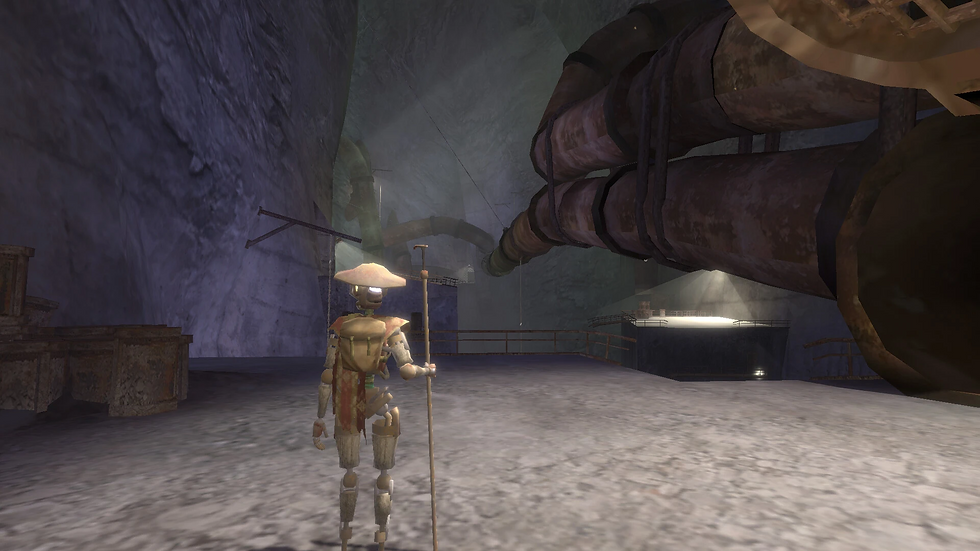
Caves of Qog
Genre: Platformer || 3D platformer
Played on: PC
Quiet and unpretentious, Hypogea is a short but thoughtful 3D platformer with a moody atmosphere and a PS2-era aesthetic. You play as a humanoid robot, exploring a large cave in which factories and dams have been built (now long abandoned, apart from the occasional robot seemingly endlessly and aimlessly maintaining elements of the facilities as the infrastructure crumbles around them).
Gameplay is slow and methodical. The avatar has a walking stick, and while the robot’s jump is fairly unimpressive, it can be aided by the stick in a number of ways: most often by using it as a pole vault, or it can be climbed upon to get a jump of additional height. These systems aren’t as expressive and dynamic as, say, the fishing pole interactions in the upcoming The Big Catch, but they serve as lock-and-key style solutions for navigational puzzles, in line with early Tomb Raider pace of play.
The low-poly visuals evoke the feeling of entering a world stuck in the past, and the low-fidelity visuals maintain that sense of the unknown and involve impressionistic reading of the visual landscape. They’re supported by terrific audio work, particularly in the distinctive sounds associated with the robot’s footsteps across different materials.
Innovation the game introduces: The pole vault feels good, and the arc of the resulting jump is responsive to the point in the arc of the vault from which the jump out of the vault is initiated.
What I'd like to see from future games: The most video game-y mechanic in this game are the pods of mushrooms that grow in certain areas. When stepped upon, the next few steps off of the platform will build new fungal platforms underneath the avatar, allowing the player to build the platform outward. This is a clever mechanic used in a few memorable puzzles, but it feels like there is more room to develop these ideas and build interesting extensions.
Lineage and legacy: In the style, graphically and control-wise, of the PS2. Calls back to the more “grown-up”, deliberate, and slow-paced 3D platformers of the PSX and PS2 eras, like Tomb Raider and The Legacy of Kain: Soul Reaver.
Score: 81


Comments